

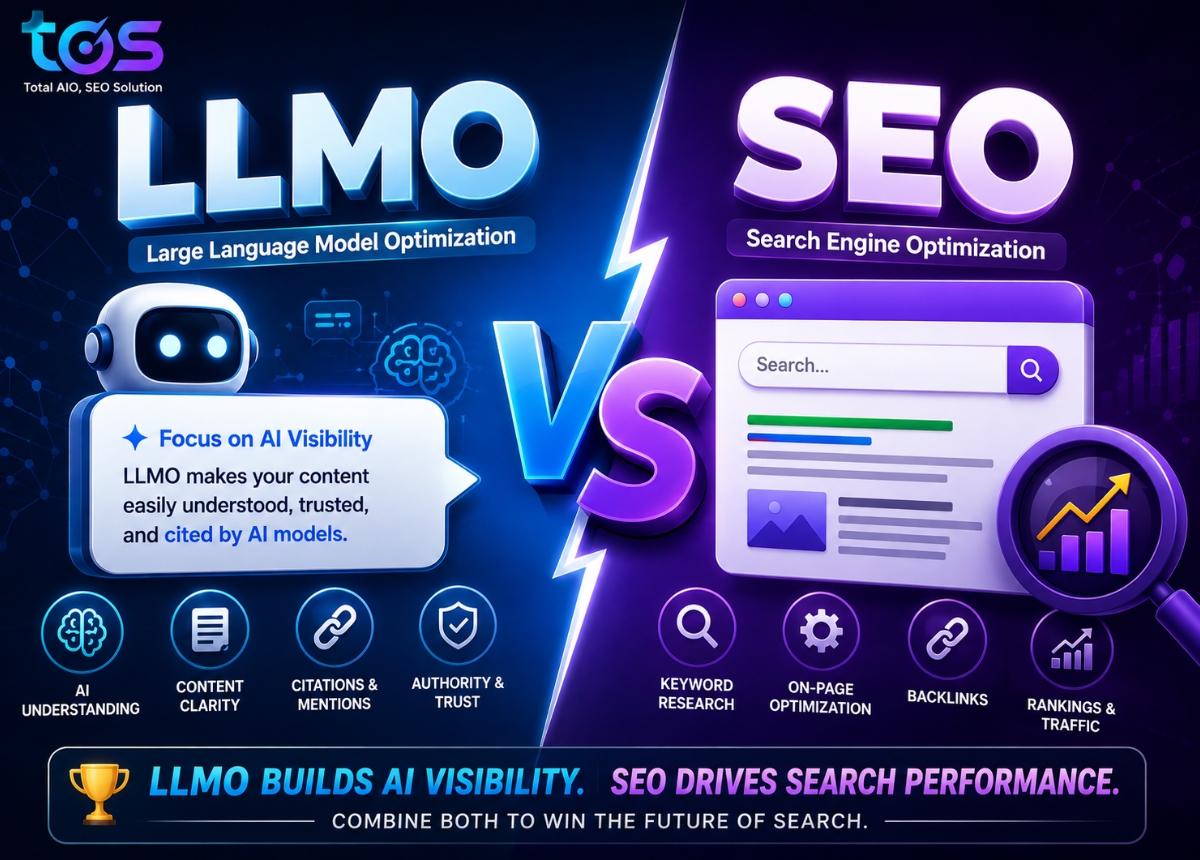



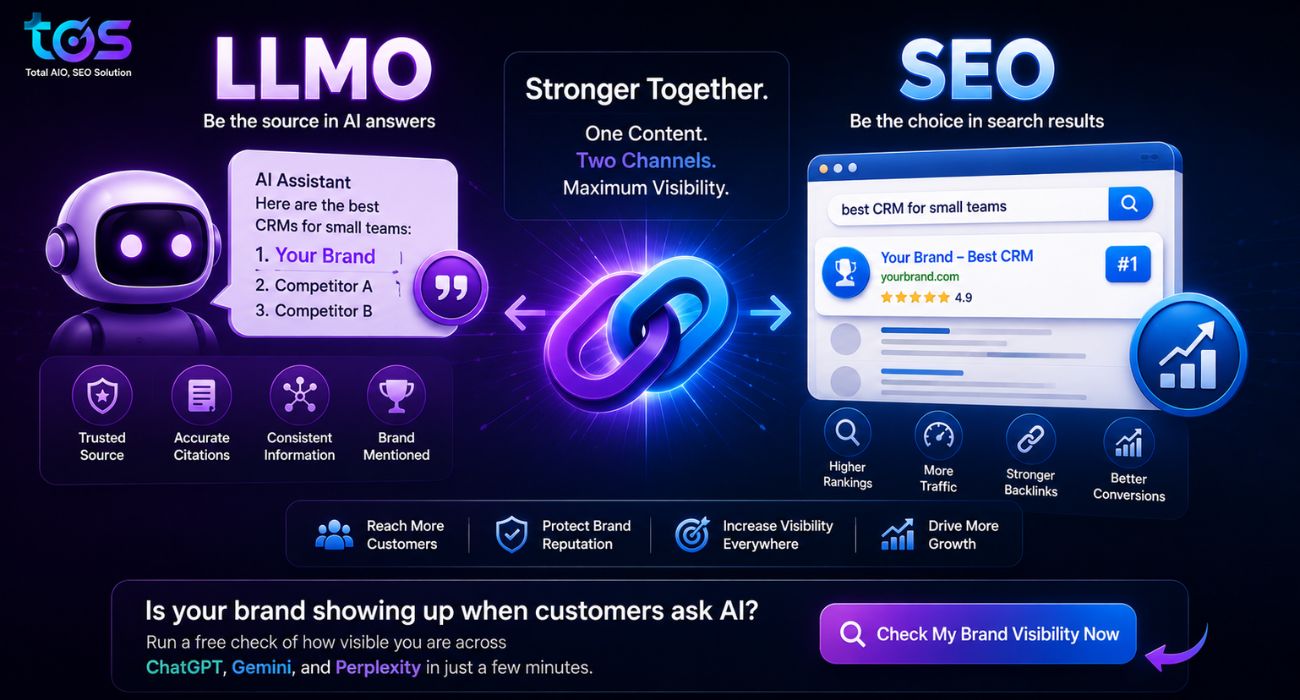
LLMO vs SEO comes down to one question. Are you optimizing to rank a page on a search engine, or to be understood, trusted, and cited inside an AI-generated answer? SEO (Search Engine Optimization) helps your pages rank on search engine results pages. LLMO (Large Language Model Optimization) shapes your content for large language models such as ChatGPT, Gemini, and Perplexity. It helps them understand, trust, and quote your content in the answers they generate. The two are not rivals. They form two layers of the same visibility strategy. The brands that win over the next few years will run both together instead of picking one.
LLMO vs SEO: What’s the difference?
The core of LLMO vs SEO is a difference in destination. SEO works to place your web page as high as possible on a search engine results page (SERP). The goal is for a person to see it and click through to your site. It relies on keywords, backlinks, and technical health. Crawlability, page speed, structured markup, and internal linking all support those rankings. The unit of success is a position, followed by the click it earns.
LLMO works one layer deeper. Instead of chasing a blue link, it optimizes your content for a large language model. The model needs to parse it, judge it as credible, and reuse it in an answer. The reward is not a ranking position. It is a citation: your brand named, your claim quoted, your link surfaced inside the model’s response. This shifts what matters toward clarity, factual authority, consistent entity information, structured data, and a strong presence across the sources these models learn from.
Example. A person searches “best CRM for small teams” on Google. Traditional SEO determines which pages appear in that results list, and a strong ranking earns a click. The same person might instead ask ChatGPT the same question. Now the model reads multiple sources, forms its own summary, and names two or three tools by name. LLMO determines whether your brand is one of the names the model chooses, regardless of where your page would have ranked on Google.
There is also a behavioral difference behind the two disciplines. SEO assumes a user will scan a list of results and decide which one to open. Competition is about being one of the first options a person sees. LLMO assumes the user has delegated that scanning to an assistant. The assistant reads dozens of sources and returns a single synthesized answer. In that world, you are not competing for a click on a list. You are competing to be the source the model trusts and repeats. Ranking on page one no longer guarantees a place in the answer.
Both disciplines still start from the same raw material: genuinely useful content. They measure success differently. SEO counts rankings, clicks, and organic traffic. LLMO counts how often your brand is mentioned or cited in AI answers, and whether those mentions are accurate. A page can rank beautifully and still be misquoted by an assistant. A page can sit lower in the SERP and still become the sentence a model repeats. That gap is exactly why the two disciplines need one shared program, not two separate ones.
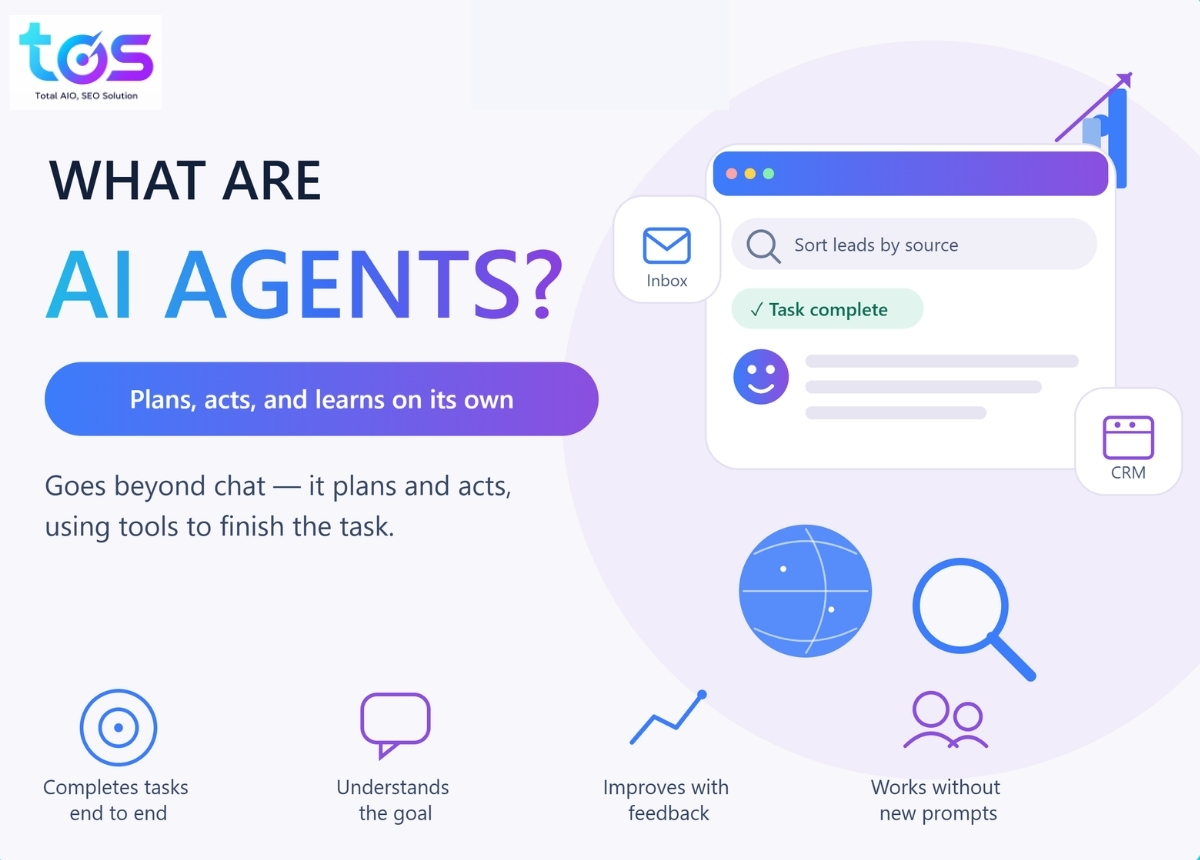
See more: AI Agents: What They Are, How They Work, and How to Use 2026
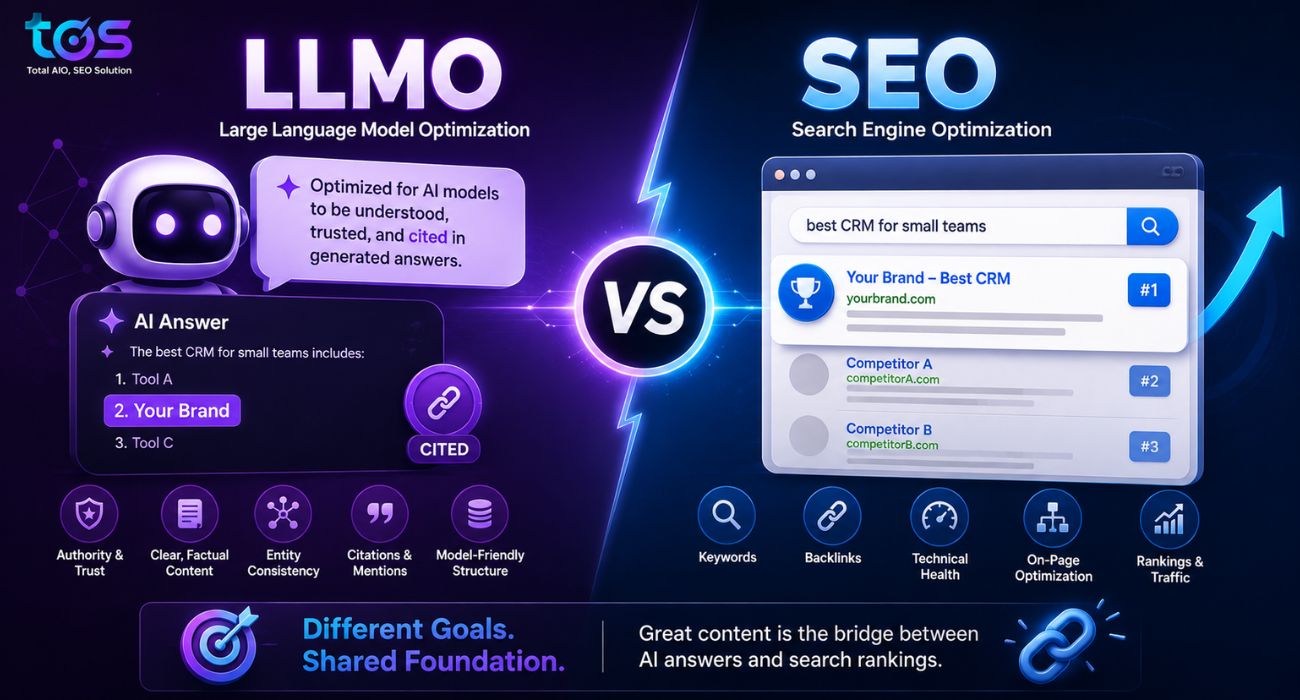
LLMO vs SEO at a glance
| Criterion | SEO | LLMO |
|---|---|---|
| Goal | Rank pages high on the SERP and earn clicks | Be understood, trusted, and cited inside AI-generated answers |
| Platform | Search engines (Google, Bing) | Large language models and AI assistants (ChatGPT, Gemini, Perplexity, Copilot) |
| What you optimize | Keywords, backlinks, technical health, on-page relevance | Clarity, factual authority, structured data, entity consistency, citable evidence |
| Content style | Keyword-targeted pages built to win a position | Answer-first, well-structured content a model can extract and quote |
| Primary unit of success | A ranking position and the click it earns | A citation or mention inside a generated answer |
| Measurement | Rankings, organic traffic, clicks | AI mentions, citations, and accuracy of how your brand is represented |
When to use each, and how they work together
You rarely choose one over the other. SEO remains essential because search engines still send the majority of trackable traffic. The pages that rank well are also often the pages large language models draw on when composing answers. Strong SEO, meaning crawlable, authoritative, well-linked content, feeds the corpus that LLMs read. If a crawler cannot reach or make sense of your page, a model trained on crawled data is unlikely to reference it either. In that sense, SEO is not a competitor to LLMO. It is the plumbing LLMO runs through.
LLMO matters most as more people ask AI assistants directly instead of scrolling a results page. Imagine a buyer asks an assistant which agency to trust for GEO. You want your brand to appear in that answer with correct, favorable context, not omitted and not described with outdated details. LLMO is closely related to Generative Engine Optimization (GEO). Both aim to be present and accurate inside generative answers. Both depend on the same underlying signals of authority and consistency.
In practice, the two reinforce each other. Publish clear, answer-first content with solid structure, and you help both a search crawler and a language model. Earn credible mentions and consistent citations across the web, and you strengthen both your rankings and your odds of being quoted by AI. The right mindset is not LLMO versus SEO. It is LLMO and SEO working as one visibility system, where a single investment in content quality pays out on two channels at once.
See more:
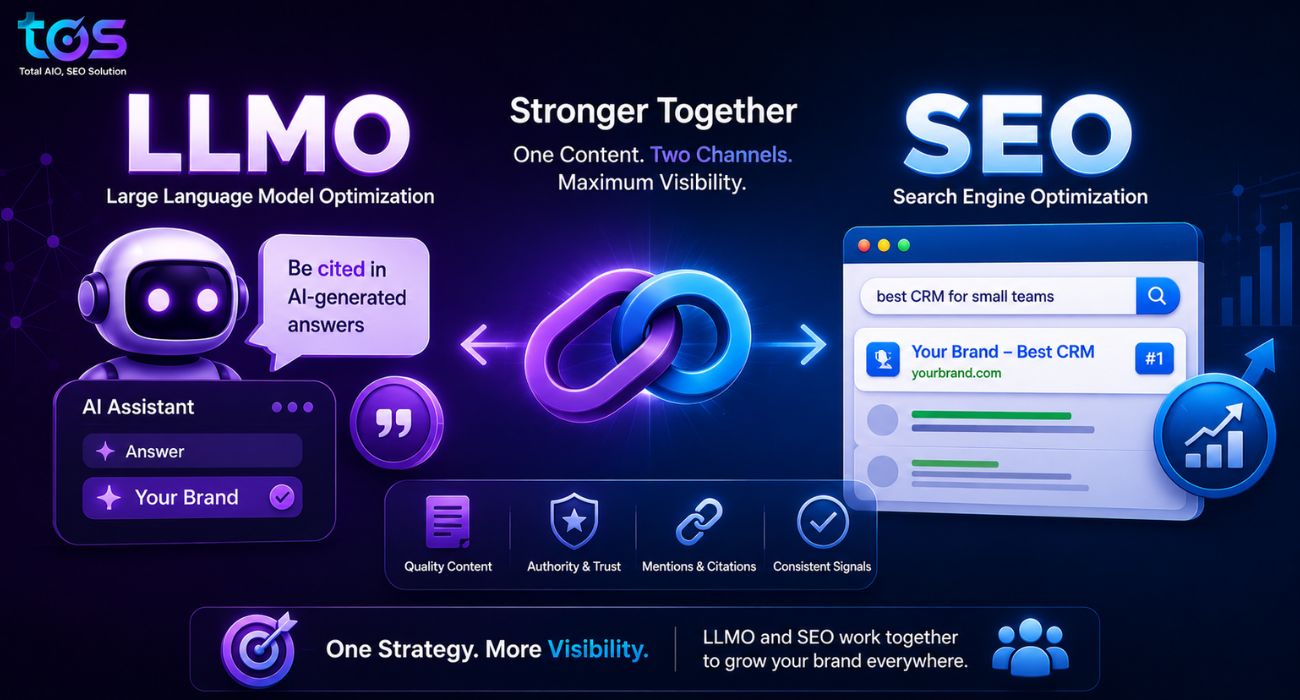
Why running both matters right now
Search behavior is splitting into two habits that coexist. Some questions still start on Google. A growing share start inside an assistant. If you optimize only for the SERP, you stay invisible in the answers assistants generate for that second group. Those answers increasingly shape the first impression a buyer forms about your brand. If you chase only AI citations and neglect technical SEO, you starve the corpus the models read from. You also lose the search traffic that still converts today. Betting on one channel leaves half your potential audience unaddressed.
Running both also protects the accuracy of your brand story. An assistant that cannot find clear, consistent information about you will still answer the user’s question. It will simply fill the gap with whatever it can piece together, sometimes incorrectly. A joined-up LLMO and SEO program gives every engine, human or machine, one clean, well-structured version of who you are. It also explains why you can be trusted.
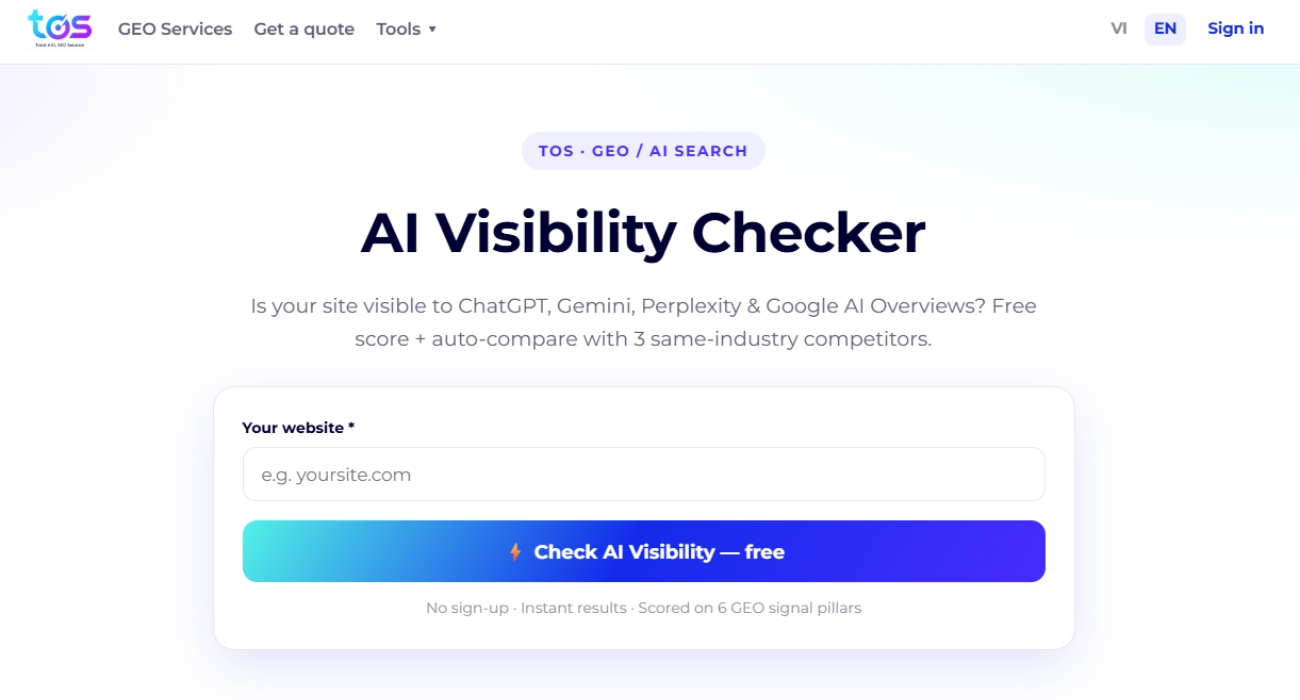
See how ready your website is for AI search.
The free TOS AI Visibility Checker scores your website on the 6 GEO signal pillars that affect how likely ChatGPT, Gemini, and Perplexity are to cite it.
Getting started (TOS angle)
At the best SEO Agencies in Vietnam – TOS, we treat search visibility and AI visibility as a single roadmap, not two competing budgets. A practical starting sequence looks like this:
- Keep your SEO foundation strong. Fix crawlability, page speed, internal links, and on-page relevance so both engines and models can read you. Nothing else works if the page cannot be reached and parsed first.
- Write answer-first. Lead each page with a clear, quotable answer. Support it with structure, including headings phrased as questions, tables, and concise definitions a model can lift cleanly without distorting your meaning.
- Add structured data and entity consistency. Use schema markup, and keep your name, claims, and facts identical everywhere. This helps models associate them confidently with your brand instead of guessing.
- Build citable authority. Publish original, verifiable content, and earn mentions across trusted sources. This gives language models concrete reasons to trust and reference you.
- Measure both worlds. Track rankings and organic traffic alongside how often, and how accurately, AI assistants mention or cite your brand. Then close the gaps you find.
How TOS approaches LLMO and SEO (and what makes it different)
Most definitions of LLMO vs SEO stop at theory. TOS works the problem in a specific context: the Vietnamese market and bilingual (Vietnamese and English) audiences. The same brand often needs to be understood correctly by assistants answering in two languages. That raises a practical challenge generic guides skip. Your entity, claims, and key facts have to stay consistent across both Vietnamese and English content. Otherwise, a model will describe you differently depending on the language it answers in.
Our method is deliberately sequential rather than a checklist. We start by writing answer-first, so each page opens with a clean, quotable statement a model can reuse. We build a coherent entity: a consistent name, positioning, and facts across every page and both languages. This helps assistants associate the right information with your brand. We optimize for generative engines (GEO) in phases instead of all at once, tightening structure, schema, and authority signals step by step. TOS tracks the outcome by checking how ChatGPT, Gemini, and Perplexity answer real buyer questions, and uses an AI Visibility Check to score the 6 GEO signal pillars that affect how likely they are to cite you. One practical note most definition articles miss: winning an AI citation is not a one-time fix. Assistants re-read the web over time, so entity consistency and content maintenance matter as much as the initial optimization.
- GEO Audit: How to Audit Your Site’s AI Visibility
- The Best GEO Tools in 2026: Top 10 Ranked
- How to Get Cited by AI: ChatGPT, Gemini & Perplexity
Frequently asked questions
Is LLMO replacing SEO?
No. In the LLMO vs SEO comparison, LLMO is an added layer, not a replacement. Search engines still drive substantial traffic, and the content that ranks well is often exactly what language models reference. The smart move is to run both together.
What does LLMO stand for?
LLMO stands for Large Language Model Optimization. It is the practice of shaping your content so large language models understand it, trust it, and cite it when generating answers for users.
How do you measure LLMO results?
You track how frequently your brand is mentioned or cited across AI assistants, and whether those mentions describe your brand accurately. This differs from SEO’s focus on rankings, clicks, and organic sessions. An AI Visibility Check complements this by scoring the on-site signals that affect whether assistants cite you.
Do LLMO and SEO use the same content?
They can share the same foundation. Clear, well-structured, authoritative content serves both. LLMO simply adds emphasis on answer-first phrasing, structured data, entity consistency, and citable evidence, so a model can extract and quote your content confidently.
How is LLMO related to GEO?
They overlap heavily. GEO (Generative Engine Optimization) is the broader practice of being present and accurate inside generative answers. LLMO is the part focused specifically on how large language models understand and cite your content. In practice, they share the same signals: clarity, authority, structured data, and entity consistency.
Is LLMO the same as AEO (Answer Engine Optimization)?
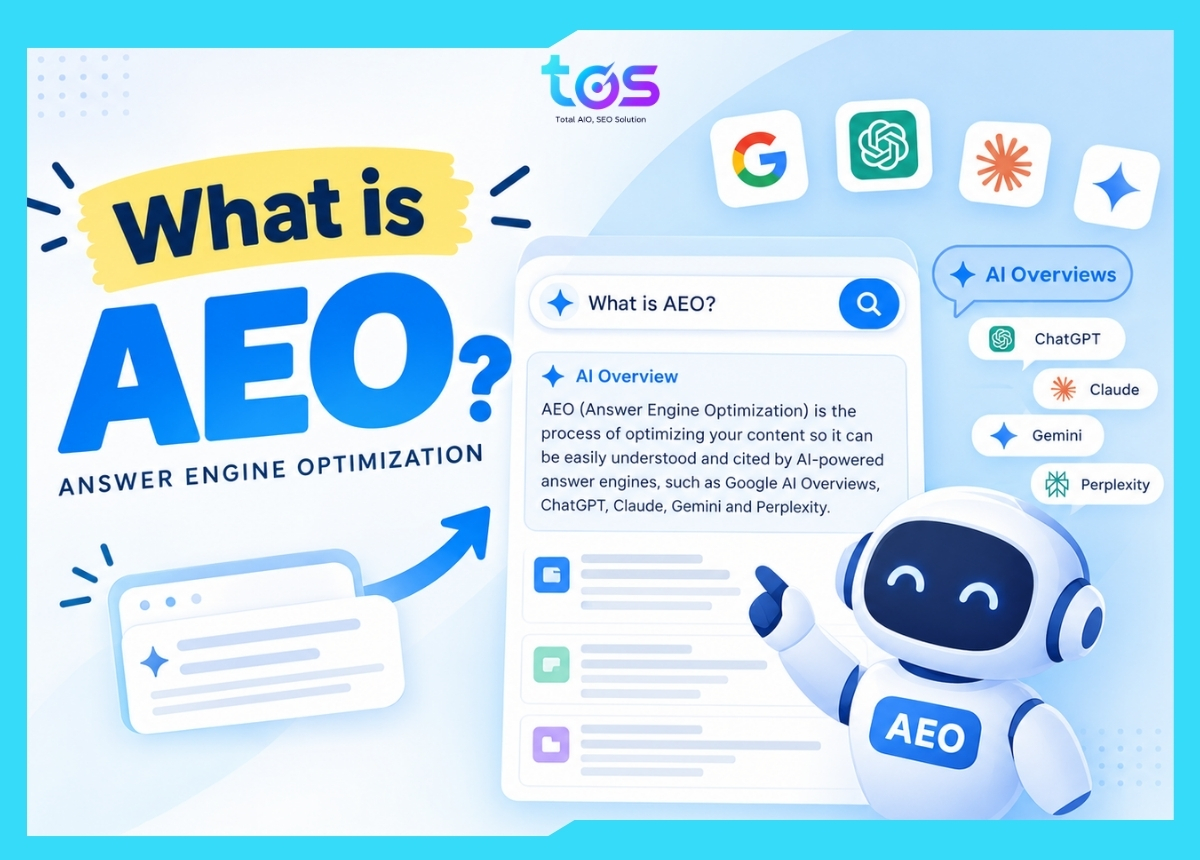
Not quite, though the two overlap closely. AEO focuses on winning a spot in direct answer formats, such as featured snippets, voice search results, and AI-generated summaries. LLMO focuses specifically on how large language models interpret, trust, and cite your content when generating those answers. In practice, most LLMO work also improves AEO performance, since both reward clear, well-structured, answer-first content.
Which should I invest in first?
Start with a strong SEO foundation. Both humans and models depend on content that can be crawled, read, and trusted. Then layer LLMO on top: answer-first structure, schema, and consistent entity information. This helps the same content earn citations inside AI answers too. The two disciplines are cheaper to build together than to retrofit one onto the other later.
TOS helps you win on both fronts of LLMO vs SEO, from search rankings to citations inside generated answers. Start with an AI Visibility Check to see the gaps in your website’s GEO signals. Then let the TOS team build the answer-first, bilingual, entity-consistent foundation that closes them.
 TOS · Search AI Agency
Get fresh SEO & AI insights — every day
Curated, practical, no spam. Join marketers who read TOS first.