




A context window is the maximum number of tokens an AI model can process in a single conversation. Think of it as the model’s working space. Every prompt you send, document you paste, and reply the model generates must fit within this limit. When you understand how it works, you can feed AI tools the right amount of information, keep long chats coherent, and avoid paying for tokens you do not need. This guide explains what a context window is, how it differs from model to model, why it directly affects cost and quality, and the practical habits that let a modest window outperform a huge one.
What is a context window?
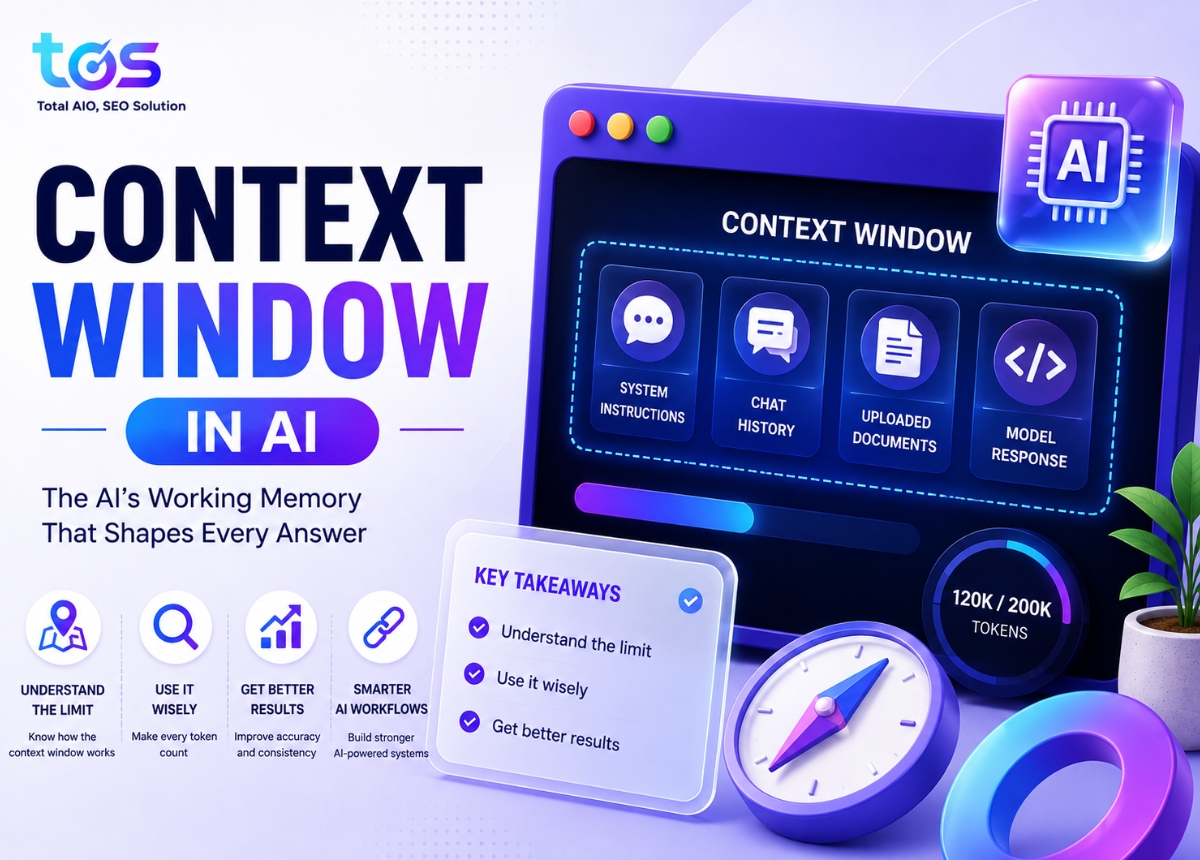
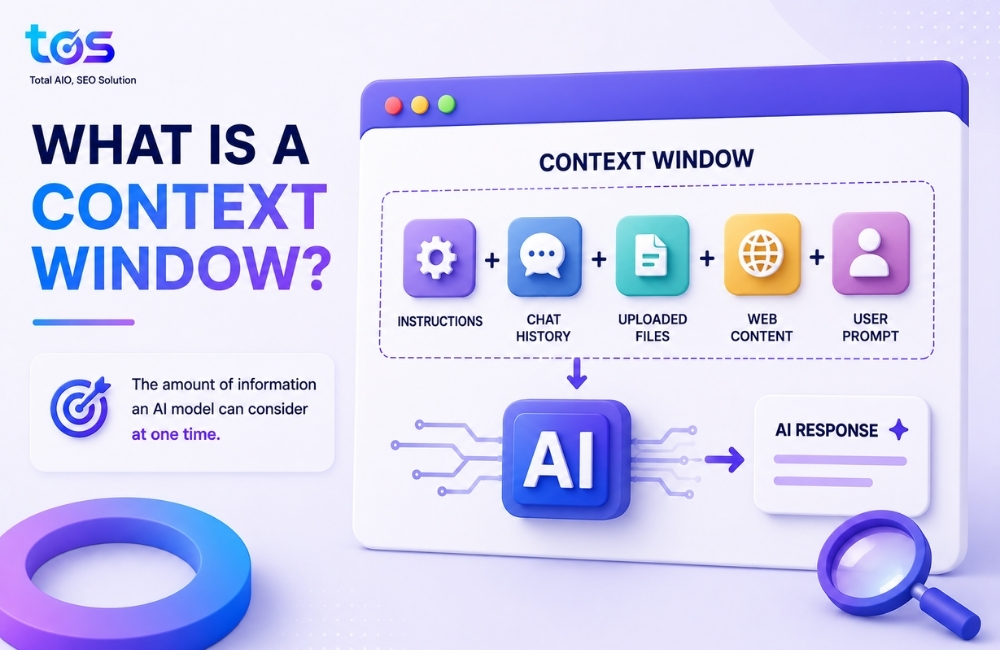
A context window is the maximum amount of text an AI language model can process at once, measured in tokens. It works like short-term working memory: anything inside the window, such as system instructions, previous messages, pasted documents, attached files, and the model’s response, can influence the answer. Anything outside it is not directly available to the model in that turn.
A token is a small unit of text. As a rough guide, one token is about four English characters or roughly 0.75 words, although this varies by language and text type.
Think of a context window as a fixed-size whiteboard. When the available space is full, new information may require older content to be trimmed or removed, which can cause the model to lose track of earlier details. This is why context window size can become an important limitation when working with long documents or lengthy conversations.
>>> Related article: AI token cost to write GEO/SEO content
What is a token?
A token is a small chunk of text – often a whole word, part of a longer word, a space, or a punctuation mark – that a language model uses as its basic unit of processing. Models do not read letters or words directly; a tokenizer first breaks text into these tokens and then converts them into numbers. As a rough rule of thumb for English text, one token corresponds to about four characters, or roughly three-quarters of a word, although this ratio changes with the language and the specific tokenizer. Because the context window is measured in tokens rather than words, the same character count can use different numbers of tokens across languages and models.
Context Window and LLMs: Why are they connected?
A context window is a fundamental concept in Large Language Models (LLMs) such as GPT, Claude, Gemini, and DeepSeek.
Modern LLMs are built on Transformer architectures, which use an attention mechanism to determine which pieces of information are most relevant when generating a response. The model can only attend to information that fits inside its context window. Once content falls outside that window, it becomes unavailable during inference.
This is why context length is one of the most important specifications of an LLM. A larger context window allows a model to analyze longer documents, maintain coherent conversations for extended periods, and reason across multiple sources without losing important details.
While larger context windows allow models to process more information at once, the ideal context size depends on the task rather than the biggest available number.
| Model Family | Context Window Capacity | Strengths | Best For |
| GPT | Varies by version | Strong reasoning and broad ecosystem support | Business, content, coding |
| Claude | Very large context support | Long-document comprehension | Research, legal, enterprise documents |
| Gemini | Extremely large context capabilities | Multi-modal and large-scale analysis | Large datasets, enterprise AI |
| DeepSeek | Varies by deployment | Cost-effective reasoning and coding | Development and technical workflows |
How the Context Window Works and How It Differs by Model
The size of the context window varies significantly across models. The newest frontier models can handle very large windows, up to roughly one million tokens, while many widely used models support around 500K or 200K tokens. Older or lightweight models may offer far less. Larger is not always better, but a bigger window lets the model reason over more material at once without requiring you to split it into smaller pieces.
One detail that often surprises people is that the window is shared between input and output. A portion of it is reserved for the model’s response, so the usable limit for your prompt is slightly smaller than the headline number. If a model advertises a 200K-token window and reserves space for its reply, you cannot fill all 200K with input and still expect a long answer. The three components below all draw from the same token budget:
- Input tokens – your instructions, chat history, and attached documents.
- Output tokens – the response the model writes, drawn from the same budget.
- Reserved space – a buffer set aside for the reply, which lowers the practical input limit.
Because tokenization depends on the language and content, the same context window can hold different amounts of text depending on the situation. Dense code, tables, or non-English text often use more tokens per word than plain English prose. Vietnamese, for example, may use more tokens than English to express the same idea because of differences in tokenization and word segmentation. This is a practical consideration for bilingual teams when planning token usage. The table below shows how a few common window sizes translate into approximate English word counts.
| Context window | Approx. English words | Typical use case |
| 8K tokens | ~6,000 words | Short chats, single emails, quick edits |
| 32K tokens | ~24,000 words | Long articles, meeting notes, small documents |
| 200K tokens | ~150,000 words | Full contracts, reports, medium codebases |
| 1M tokens | ~750,000 words | Large document sets, whole repositories |
Keep in mind that these figures are estimates for English prose. The same window will hold noticeably fewer words of code or of a language with heavy diacritics, and the reserved output space means you should never plan to fill the window right to the last token.
>>> Related articles: AI token price & real cost for content
Long-Context LLMs and Modern AI Systems
Recent advances in AI have led to the development of long-context LLMs capable of processing hundreds of thousands or even millions of tokens. While earlier Transformer models often supported only a few thousand tokens, modern systems can handle entire code repositories, large knowledge bases, and lengthy reports within a single context window.
These improvements enable use cases such as enterprise knowledge retrieval, full-document analysis, multi-document reasoning, and AI-assisted research workflows.
What happens when an AI Reaches Its Context Window limit?
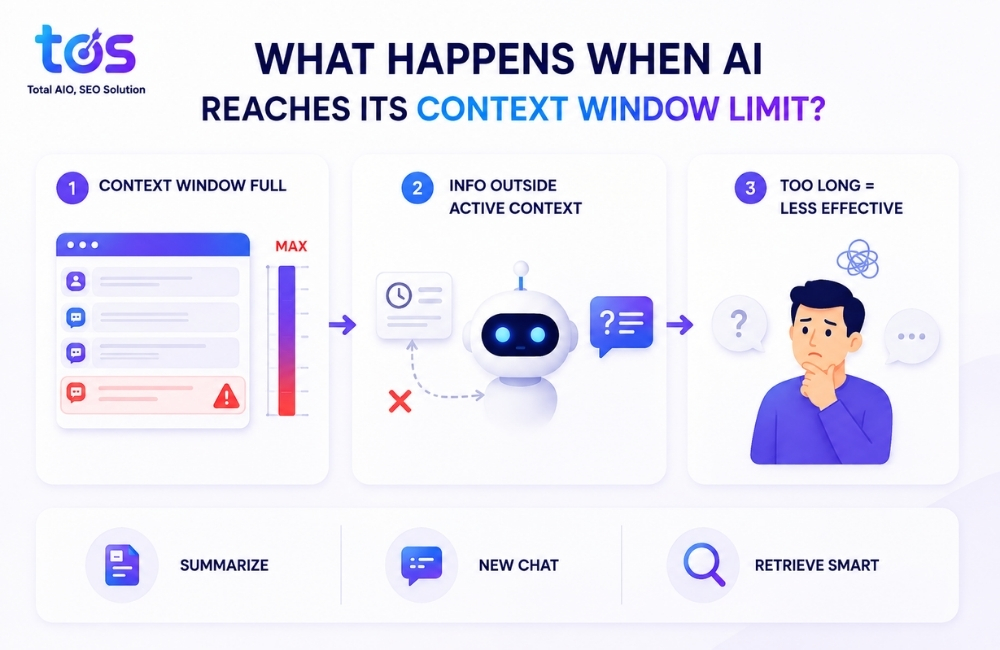
When the available context is full, the model cannot keep adding information indefinitely. Depending on the AI system, older conversation content may be trimmed, summarized, or otherwise removed from the active context to make room for new input.
Once information is outside the active context, the model can no longer use it in the same way. This may cause the AI to lose track of earlier instructions, repeat questions, or miss details from a long conversation.
The practical takeaway is simple: when a conversation becomes too long, reduce the amount of active context rather than continuing to add information. Summarizing the discussion, starting a new chat, or retrieving only the relevant parts of a document can help keep the context manageable.
Context Window vs Memory: Are they the same?
Many users assume that context windows and AI memory are the same thing, but they serve different purposes.
A context window represents the information currently available to the model during a conversation. Memory, on the other hand, refers to information that may be stored and retrieved across different sessions.
For example:
- Context Window → Information available right now
- Memory → Information stored for future use
This distinction explains why an AI assistant may remember certain preferences through a memory feature while still forgetting details from a conversation that exceeded its context limit.
Why the context window matters?
The context window shapes three things you care about every day when working with AI.
- How much you can process at once. A larger window lets the model read a long report, contract, or codebase in a single pass instead of splitting it into smaller pieces. This can reduce round trips and produce answers that account for the whole document rather than just a fragment.
- How much the model “remembers.” In a long conversation, anything that falls outside the window is no longer available to the model. That is why an assistant may lose track of an instruction you gave many messages earlier, or start contradicting a decision made at the top of the chat.
- How much it costs. Most AI providers bill per token. More tokens in the window can mean a higher cost per request, so filling a large window with irrelevant text can waste money and slow the response.
There is also a quality dimension that gets less attention. Even when everything technically fits, models can struggle to use information buried in the middle of a very long context. This phenomenon is sometimes called “lost in the middle.” Placing the most important instructions and facts near the start or end of your prompt can help. Keeping the context focused often produces sharper answers than including everything you have.
For teams publishing content that AI systems read and cite, understanding token limits also connects to how models process your pages. If you want your brand to show up in AI answers, it helps to understand the broader field of Generative Engine Optimization (GEO), where structure and clarity make your content easier for models to ingest within their working memory.
See how ready your website is for AI search. The free TOS AI Visibility Checker scores your website on the 6 GEO signal pillars that affect how likely ChatGPT, Gemini and Perplexity are to cite it.
Why Bigger Context Windows Are Not Always Better?
A larger context window is useful, but it does not automatically guarantee better results.
One challenge is a phenomenon known as “Lost in the Middle.” Research has shown that language models often pay more attention to information located near the beginning or end of a prompt than information buried deep in the middle.
Large context windows can also introduce:
- Attention dilution – the model must distribute attention across more tokens.
- Higher latency – processing more tokens requires additional computation.
- Increased costs – larger inputs typically result in higher usage costs.
In many situations, a focused prompt with relevant information produces better results than a massive prompt filled with unnecessary content.
How context windows relate to GEO and AI search?
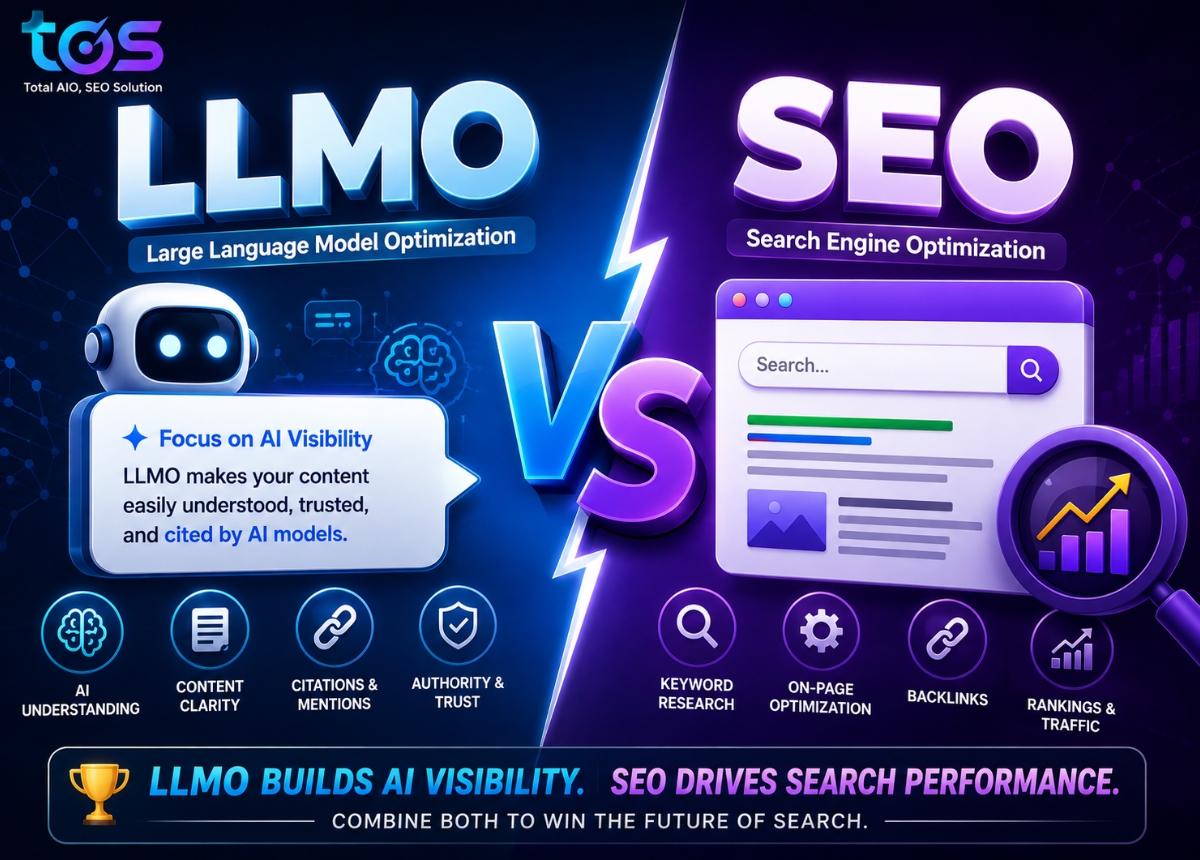
Context windows shape how AI search and answer engines read web content, because those systems pull pages into a model’s window before generating a response. When a passage is concise, well-structured, and self-contained, more of its meaning survives inside the window and is easier for the model to reuse in an answer. This is central to large language model optimization (LLMO), which focuses on making content legible to LLM-driven discovery. Content that is padded or buried is more likely to be truncated or overlooked, while clear headings, direct answers, and tight paragraphs help the same information fit and be understood.
How to optimize your context window?
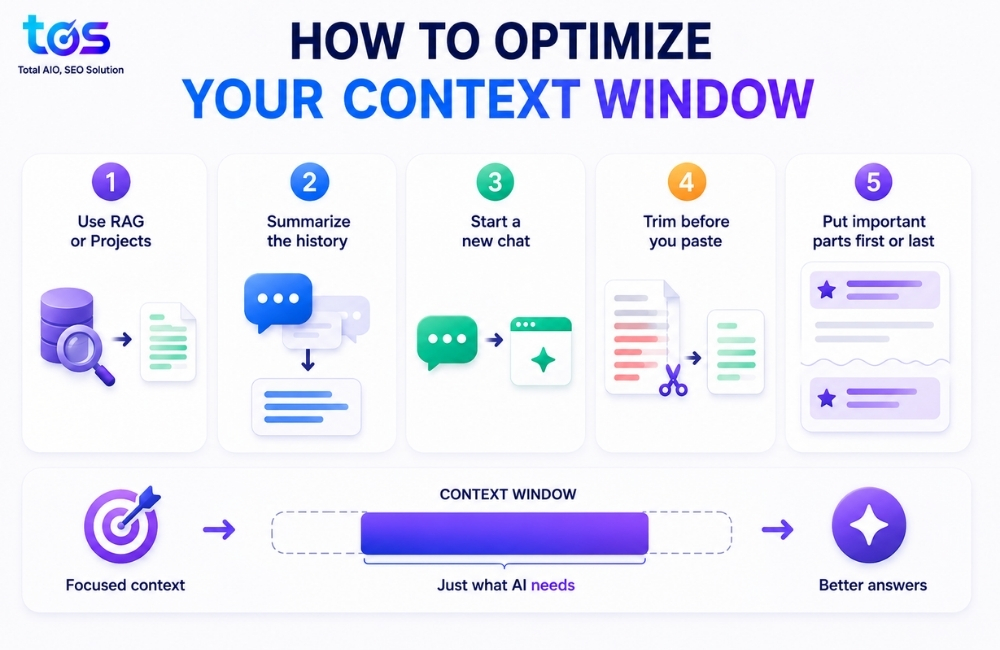
You rarely need to fill the entire context window. The goal is to give the model exactly what it needs and nothing more. A few practical habits go a long way.
- Use RAG or Projects. Retrieval-augmented generation and “project” features pull in only the relevant snippets of your documents instead of pasting everything, keeping the context window lean while still grounding answers in your material.
- Summarize the history. In a long chat, ask the model to condense the discussion so far, then continue from the summary rather than carrying every message forward.
- Start a new chat. When a conversation drifts to a new topic, opening a fresh session clears old context and reduces cost and confusion.
- Trim before you paste. Remove boilerplate, repeated headers, and irrelevant sections from documents so more of the window goes to what actually matters.
- Put the important parts first or last. Lead with your core instruction and key facts, and restate the ask at the end of a long prompt, so the model is less likely to overlook them.
Managed well, a modest window is often enough. The best results come from a focused prompt, not from stuffing the largest possible context window with everything you have. If you regularly work near the limit, it is worth measuring how many tokens your typical prompts actually use – most providers expose token counts – so you can right-size both the model and the input to the job.
>>> Related articles:
How TOS approaches context windows (and what makes it different)
Most explainers stop at the definition. At TOS, the context window is a practical lever in how we make content and brands legible to AI systems in the Vietnamese and bilingual market – where a page often needs to work in both Vietnamese and English, and where Vietnamese text consumes more tokens per idea. Our method is deliberately answer-first: we lead each page with a clear, self-contained answer, then build out supporting entities and structure so a model can lift the essentials cleanly even when it only ingests part of the page within its working memory.
We optimize the same content across VI and EN rather than treating translation as an afterthought, and we roll out Generative Engine Optimization in stages instead of all at once, scoring the on-site GEO signals with the free AI Visibility Check and adjusting from there. The practical caution that pure definition articles tend to miss: bigger windows do not fix messy content. If your most important claim is buried mid-page or split across languages inconsistently, a model may still overlook it – so structure and placement matter as much as raw window size.
As AI assistants become the front door to information, the way models read and remember your content directly affects whether your brand gets mentioned. TOS helps you structure content so it lands cleanly inside a model’s context window and surfaces in AI-generated answers. Score your website on the 6 GEO signal pillars with the free AI Visibility Check, then let our team map out the next steps for your brand.
In this landscape, brands need more than traditional SEO to stay visible. TOS, is the best SEO Companies in Vietnam, helps businesses build stronger visibility across search engines and AI platforms through:
Our solutions help you improve how your brand appears in AI-generated answers, strengthen organic search performance, and turn traffic into business results. Start with our free [AI Visibility Check] to score your website on the 6 GEO signal pillars, then explore the TOS service that best fits your goals.
Contact us:
- Website: www.toponseek.com/en/
- Phone: +84 28 73022 558
- Email: long.bui@toponseek.com
- Office: Ho Chi Minh City & Da Nang, Vietnam
Frequently asked questions (FAQ)
Not necessarily. A larger window helps when you genuinely need to reason over long material, but it also costs more per request and can dilute the model’s focus. Matching the window to the task usually beats maximizing it.
As a rough estimate, one token is about 0.75 English words, so a 200K-token window holds roughly 150,000 words. The exact figure depends on the language and the type of content, and non-English text or code fits fewer words per token.
Yes. Input and output share the same budget, and a portion is reserved for the response. That is why the usable limit for your prompt is a little smaller than the advertised window size.
When a conversation grows past the context window, the oldest messages are trimmed to make room. Anything pushed out is no longer visible to the model, so it can lose track of earlier instructions.
They are closely related. The token limit is the number the provider quotes; the context window is that same budget in action, covering your input, the chat history, and the reserved output. In practice people use the terms interchangeably.
Often, yes. The model has to process every token in the window, so a fuller window can mean higher latency as well as higher cost. Keeping the input focused helps both speed and price.
Not by itself. Once information falls outside the active context window, the model cannot directly access it unless that information is retrieved through memory systems, databases, or retrieval mechanisms such as RAG.
Not entirely. RAG and large context windows solve different problems. RAG improves efficiency by retrieving only relevant information, while larger context windows allow more information to be processed simultaneously. Many advanced AI systems use both approaches together.
References
 TOS · Search AI Agency
Get fresh SEO & AI insights — every day
Curated, practical, no spam. Join marketers who read TOS first.