

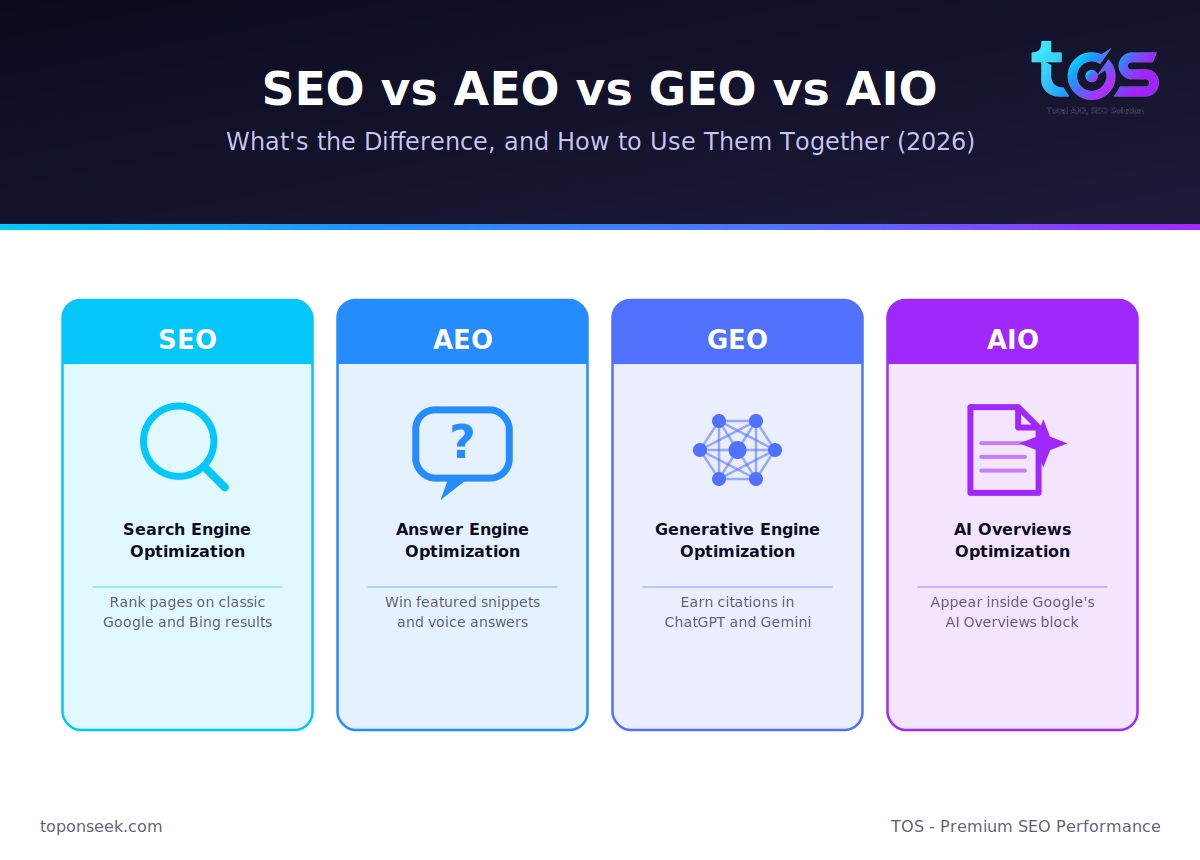



AEO, SEO, GEO and AIO are four related but distinct optimization disciplines: SEO ranks your pages on classic search results, AEO makes your content the direct answer in snippets and voice, GEO earns citations inside generative AI engines, and AIO wins a spot in Google’s AI Overviews. They share the same DNA – helping the right audience find your brand – but each one optimizes for a different surface, a different ranking logic, and a different definition of success. Understanding how they differ, and how they reinforce one another, is the foundation of any modern visibility strategy as search fragments across results pages, answer engines, AI chatbots, and AI Overviews.
AEO vs SEO vs GEO vs AIO: the quick answer
Here is the short version before we go deeper. SEO (Search Engine Optimization) focuses on ranking your web pages on traditional search results pages through keywords, links, and technical health. AEO (Answer Engine Optimization) shapes your content so it becomes the direct answer inside featured snippets, voice assistants, and answer engines. GEO (Generative Engine Optimization) works to get your brand cited and reused by generative AI engines such as ChatGPT, Gemini, and Perplexity. AIO (AI Overviews Optimization) targets one specific surface: appearing inside Google’s AI Overviews at the top of the results page.
They overlap heavily and complement each other. None replaces the others, and a brand that wants to stay visible across every discovery channel needs a deliberate blend rather than a single tactic. A useful mental model: SEO is the foundation, AEO and GEO are two ways of packaging the same authority for machines to reuse, and AIO is a high-value slice of GEO that happens to live on Google’s most-viewed real estate.
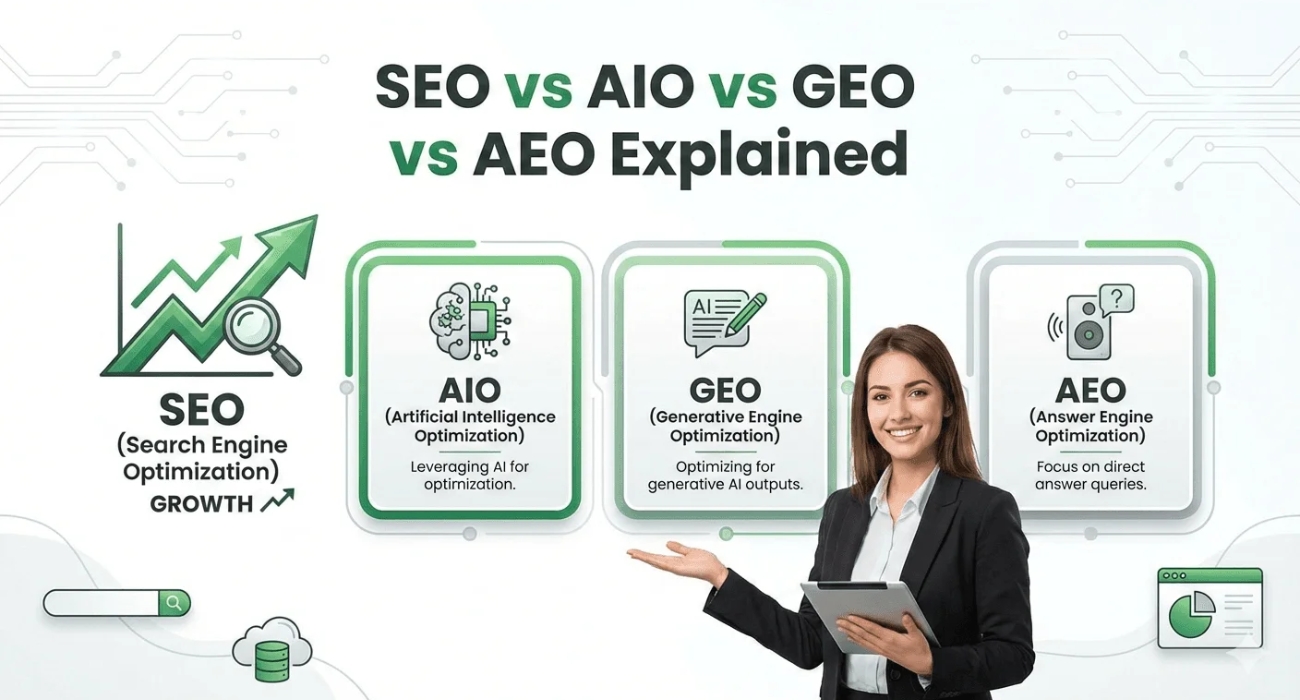
The four approaches side by side
The table below compares SEO, AEO, GEO, and AIO across the dimensions that matter when you plan and measure work. Read it as a planning grid: each row is a surface you can choose to compete on, and the last column tells you what a win actually looks like there.
| Approach | Goal | Platform / surface | Core tactics | How you measure |
| SEO | Rank pages high on organic results | Traditional SERPs (Google, Bing) | Keyword research, quality content, backlinks, technical health, page speed | Rankings, organic traffic, clicks and impressions |
| AEO | Become the single direct answer | Featured snippets, voice assistants, answer boxes | Concise answer-first copy, Q&A structure, schema, entity clarity | Snippet ownership, voice answer share, zero-click visibility |
| GEO | Be cited and reused by AI models | ChatGPT, Gemini, Perplexity, Copilot | Authoritative, well-sourced content, clear facts, strong entity signals | Citations and mentions inside AI answers, referral traffic from AI tools |
| AIO | Appear inside Google AI Overviews | Google AI Overviews block | Answer-first passages, structured data, topical depth, trusted sourcing | Inclusion in AI Overviews, brand mentions, assisted visibility |
Each discipline explained in more depth
SEO: the durable foundation
SEO remains the base layer. It is about making your website easy for search engines to crawl, understand, and trust, then earning rankings for the queries your audience uses. The classic pillars still apply: relevant content that matches intent, a clean technical setup, fast pages, a sensible internal link structure, and credible backlinks. Everything else in this article builds on top of solid SEO, because answer engines and AI models still lean heavily on the same signals of relevance and authority that power organic rankings.
Concretely, an SEO workflow looks like this: map the topics your audience searches, group them into clusters with a pillar page and supporting articles, write for search intent rather than keyword density, and keep the technical foundation healthy – indexable URLs, sensible titles and headings, internal links that pass context, and Core Web Vitals that do not punish mobile users. When these fundamentals are missing, no amount of answer-engine or AI optimization can compensate, because the machines that build snippets and AI answers are drawing from the same index.
AEO: optimizing to be the answer
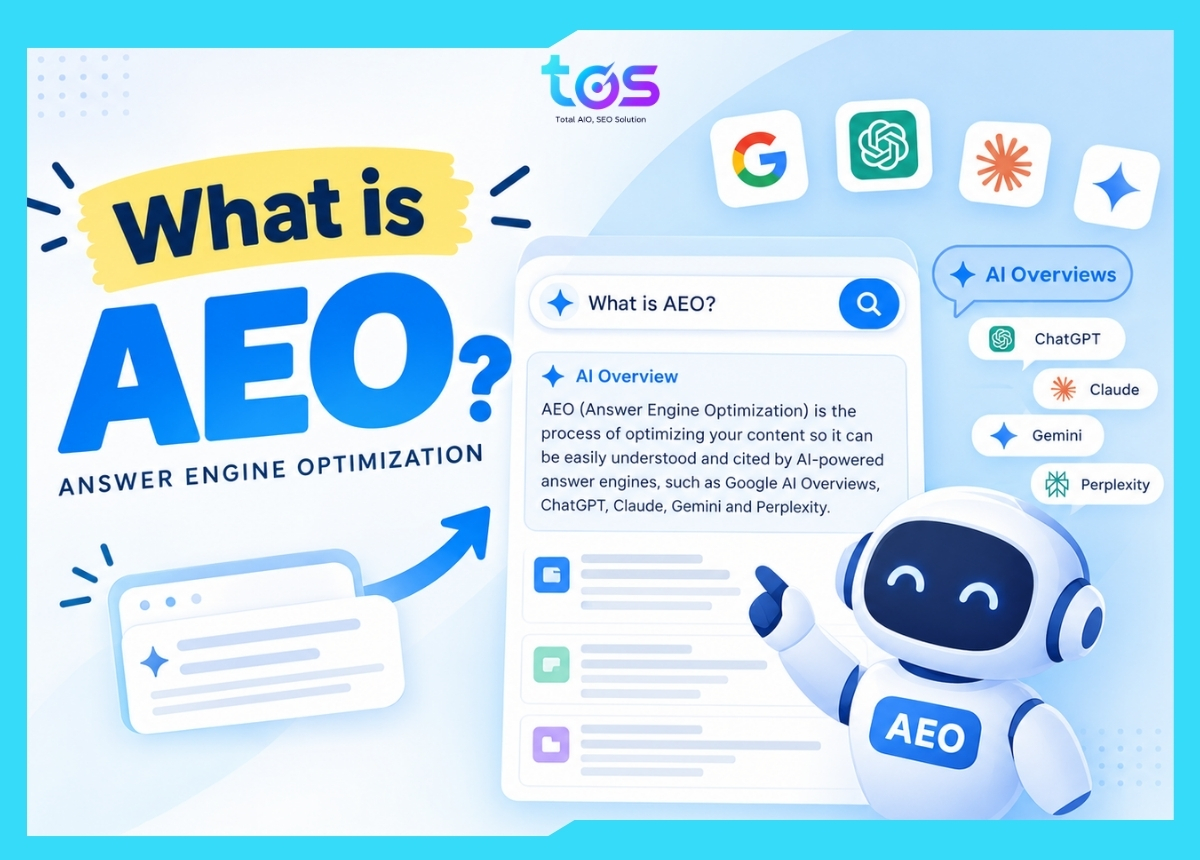
Answer Engine Optimization shifts the target from “rank on the page” to “be the answer.” Featured snippets, voice search, and answer boxes reward content that responds to a question directly and unambiguously in the first sentence or two. That means structuring pages around real questions, leading with a tight answer before the supporting detail, and using schema and clear entities so machines can extract the response with confidence. AEO is where many teams first feel the move toward zero-click experiences, where users get their answer without visiting a site.
A practical AEO checklist: phrase a heading as the exact question a user would ask, answer it in one or two sentences immediately below, then expand. Add FAQ and How-To structured data where it genuinely fits, keep definitions self-contained so they read well out of context, and make sure your brand and product names are used consistently so the answer engine knows which entity it is quoting. The payoff is that your copy becomes eligible to be lifted verbatim as the definitive response.
GEO: earning citations from generative engines
Generative Engine Optimization is the newest discipline and the fastest growing. Instead of a ranked list, tools like ChatGPT, Gemini, and Perplexity synthesize an answer and sometimes cite the sources behind it. GEO is about becoming one of those trusted sources: publishing accurate, well-structured, well-sourced content, reinforcing your entity across the web, and making your facts easy for a model to lift and attribute. If you want a deeper walkthrough, see our guide on what GEO is and how it works.
What makes GEO different from classic SEO is that you are optimizing for reuse, not just for a click. Models favor content that states facts plainly, backs them with credible references, and is consistent with what the rest of the web says about your brand. That is why entity building matters so much: the more coherently your organization is described across your own site, third-party mentions, and structured data, the more confidently a model can name you as the source. Measuring GEO means watching whether your brand shows up inside AI answers at all – which is a very different question from where you rank.
AIO: winning a spot in Google AI Overviews
AI Overviews Optimization is a focused sibling of GEO aimed at Google specifically. AI Overviews are the AI-generated summaries Google places above traditional results for many queries, and they pull from pages Google already considers relevant and trustworthy. Optimizing for them combines answer-first writing, structured data, topical depth, and the same credibility signals that drive strong SEO. Because AI Overviews sit at the very top of a huge share of searches, being included is quickly becoming a visibility priority in its own right.
Why the difference matters for your strategy
The reason this taxonomy matters is that each surface changes how – and whether – a user ever reaches your site. On a classic SERP, ranking earns a click. In an answer box or AI Overview, your content might be read without a visit, which means brand presence and being named as the source become the win. Inside a generative engine, you are competing to be part of a synthesized answer that the user trusts. If you only measure organic rankings, you will miss the visibility you are gaining – or losing – across the other three surfaces entirely.
This is also why a single-tactic strategy is now risky. A brand that is excellent at classic SEO but invisible inside AI answers is slowly ceding the moments when buyers ask a chatbot for a recommendation. The disciplines are not competing budgets; they are overlapping insurance policies against the fragmentation of search.
See how ready your website is for AI search. The free TOS AI Visibility Checker scores your website on the 6 GEO signal pillars that affect how likely ChatGPT, Gemini and Perplexity are to cite it.
Run a free AI Visibility check
How to combine them
The practical takeaway is that AEO vs SEO vs GEO vs AIO is not a choice of one winner. These approaches are layers of the same strategy, and they compound. At TOS, we position around GEO, AIO, and SEO precisely because the surfaces feed each other: a page that ranks well organically is more likely to be pulled into a featured snippet, cited by a generative model, and surfaced in an AI Overview.
- Start with SEO fundamentals. Crawlable, fast, well-linked pages with content that matches intent are the base every other layer relies on.
- Add answer-first structure for AEO. Lead sections with a direct answer, use question headings, and mark up content with schema.
- Build authority and clarity for GEO. Cite credible sources, keep facts accurate and current, and strengthen your brand as a recognizable entity.
- Target AI Overviews with depth and trust. Cover topics thoroughly, use structured data, and earn the credibility Google favors for its summaries.
Done well, one strong content asset can perform across all four channels at once – which is exactly the efficiency a blended strategy is meant to deliver. To prioritize, check how AI assistants answer your buyers’ questions today, then score your website’s GEO signals with the free AI Visibility Check.
How TOS approaches AEO, SEO, GEO and AIO (and what makes it different)
Most explainers stop at definitions. In practice, TOS treats these four as one connected system built for the Vietnamese and bilingual market, where the same brand often needs to be found in Vietnamese on Google and in English inside AI chatbots used by regional buyers. Our process starts answer-first: every page opens with a clean, extractable answer so it is eligible for snippets, AI Overviews, and AI citations at the same time. From there we build the entity – describing the brand consistently across the site, structured data, and third-party mentions – so generative engines can confidently name it as a source.
We then roll GEO out in stages rather than all at once, prioritizing the topics where buyers actually ask AI for recommendations, and we optimize each asset in both Vietnamese and English so it earns visibility across local search and global AI tools. Crucially, TOS checks AI answers directly, alongside an AI Visibility Check of the on-site signals, instead of assuming that good rankings equal good AI presence – the two often diverge. One practical caveat that definition-only articles tend to skip: Vietnamese entity signals and English entity signals have to be kept in sync, or a model will happily cite your brand in one language and overlook it in the other.
Frequently asked questions
Is AEO replacing SEO?
No. AEO builds on SEO rather than replacing it. Answer engines still rely on content that is relevant, well-structured, and trustworthy – the same qualities SEO produces. AEO simply adds an answer-first layer so your content can be extracted as the direct response.
What is the difference between GEO and AIO?
GEO is broad: it aims to get your brand cited across many generative engines like ChatGPT, Gemini, and Perplexity. AIO is narrower, focused specifically on appearing inside Google’s AI Overviews. AIO is best thought of as a Google-specific slice of the wider GEO effort.
Which one should I invest in first?
Start with SEO, because it is the foundation every other surface draws from. Once your fundamentals are solid, layer in answer-first structure for AEO and authority signals for GEO and AIO. Most brands should run all four together rather than in strict sequence.
Can one piece of content work for all four?
Yes, and that is the goal. A well-researched, answer-first, schema-supported article with credible sources can rank in organic results, win snippets, get cited by AI models, and appear in AI Overviews. Designing content for all four surfaces from the start is far more efficient than optimizing each one separately.
How do I measure visibility inside AI answers?
Classic rank trackers do not see AI answers, so you need a purpose-built check. Prompt the major engines with the questions your buyers actually ask and record whether your brand is named or cited, then track that presence over time. A free AI Visibility Check adds a quick score of the on-site GEO signals before you decide where to invest.
References
Search is no longer a single box – it is a set of surfaces spanning classic results, answer engines, generative AI, and AI Overviews. TOS helps brands win across GEO, AIO, and SEO with one connected strategy so your content performs everywhere your audience looks, in both Vietnamese and English. Start with a free AI Visibility Check to score your website on the 6 GEO signal pillars and see where the gaps are, then talk to us about closing them.
 TOS · Search AI Agency
Get fresh SEO & AI insights — every day
Curated, practical, no spam. Join marketers who read TOS first.