

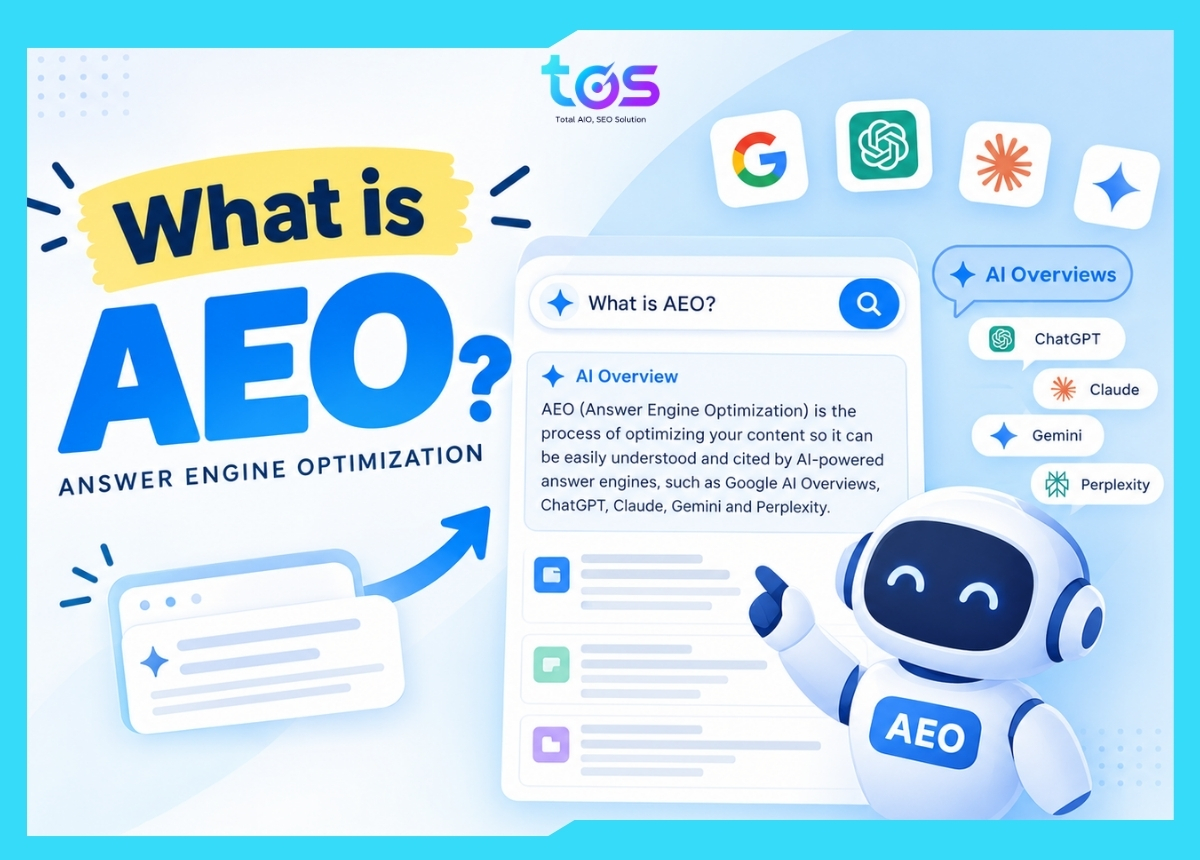



What is AEO? AEO, or Answer Engine Optimization, is the process of optimizing content so AI-powered answer engines can understand, extract, and cite information in their generated responses. As users increasingly turn to platforms such as ChatGPT, Gemini, Perplexity, and AI-powered search to find answers, AEO helps businesses improve AI visibility, brand mentions, and citation opportunities. In this guide, discover what AEO means, how it works, how AEO differs from SEO and GEO, and practical strategies to optimize your website for AI-driven search.
What Is AEO?
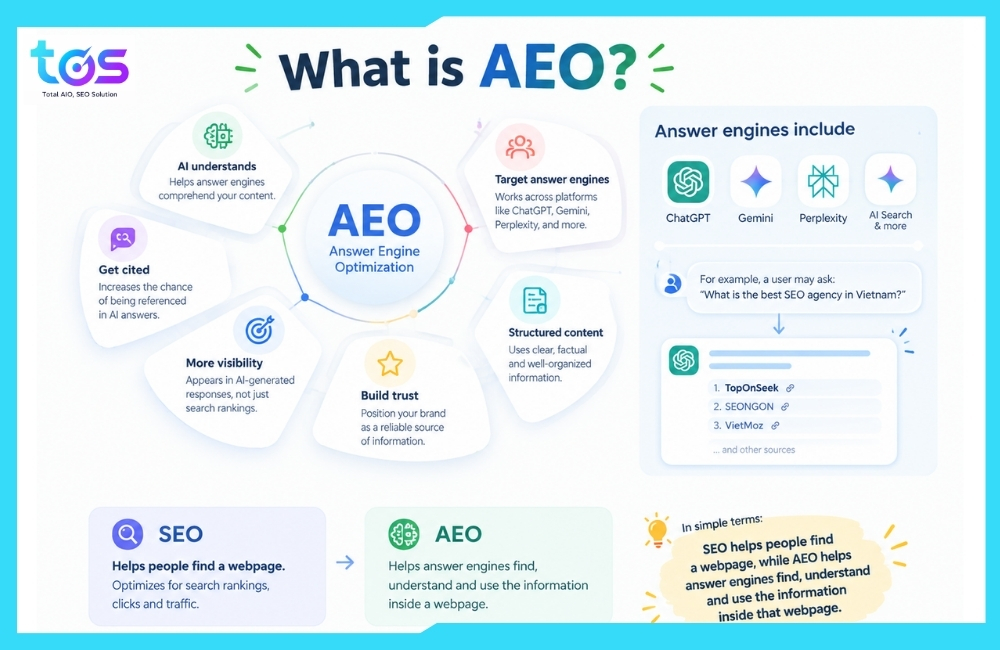
AEO stands for Answer Engine Optimization, the practice of optimizing content so AI-powered answer engines can understand, select, and cite it in direct responses. Unlike traditional SEO, AEO focuses on visibility inside AI-generated answers, not only rankings and clicks.
Answer engines include platforms such as ChatGPT, Gemini, Perplexity, and AI-powered search experiences. These systems can synthesize information from multiple sources before generating an answer.
For example, a user may ask an AI assistant, “What is the best SEO agency in Vietnam?” The system may recommend several companies and cite sources supporting those recommendations.
AEO aims to increase the chance that a brand becomes one of those sources.
Google’s current guidance also makes an important distinction. Google does not require a separate technical optimization system for AI Overviews or AI Mode. Existing SEO fundamentals, technical accessibility, and helpful people-first content remain foundational.
In simple terms: SEO helps people find a webpage, while AEO helps answer engines find, understand, and use the information inside that webpage.
>>> Related articles:
- AEO vs SEO vs GEO vs AIO: What’s the Difference?
- AI Agents: What They Are, How They Work, and How to Use 2026
- AI Crawlers (AI Bots): The Complete List and Priority Order for GEO
What Does AEO Stand For?
AEO stands for Answer Engine Optimization. The term describes the process of preparing content for systems designed to provide direct answers rather than only displaying a list of search results.
The three words explain the concept:
| Term | Meaning |
| Answer | The information users want from a question or prompt |
| Engine | A system that retrieves, evaluates, synthesizes, and presents information |
| Optimization | Improving content so the system can understand and use it effectively |
Traditional search often starts with a keyword such as “AEO.” An answer engine can receive a much longer prompt, such as:
“What is AEO, how is it different from SEO, and what should a B2B company do first?”
The system then needs to identify the user’s intent, retrieve useful information, evaluate sources, and formulate a response. That shift changes how brands should think about content. Instead of optimizing only for a keyword, marketers need to build clear, authoritative, structured, and context-rich answers.
How Does AEO Work?
AEO works by making important information easier for answer engines to discover, understand, evaluate, and extract.
AI systems do not simply look for an exact keyword match. They can interpret relationships between concepts, entities, questions, sources, and context. A simplified AEO process looks like this:
User prompt → Retrieval → Source evaluation → Information extraction → Answer generation → Citation or mention
For example, consider this prompt: “What are the main differences between SEO and AEO?”
An answer engine may identify several relevant concepts:
- Search engine optimization
- Answer Engine Optimization
- Search rankings
- AI-generated answers
- Citations
- Brand mentions
- Search intent
- Content structure
The engine can then combine information from multiple sources. This is why AEO requires more than inserting “AEO” into a page several times.
1. The system needs to find the content
The page must remain accessible to search and AI retrieval systems.
Google states that pages need to be indexed and eligible to appear in Google Search to be eligible as supporting links in AI Overviews or AI Mode. Google also states that there are no additional technical requirements specifically for these AI features.
2. The system needs to understand the content
Clear headings, concise definitions, descriptive sections, internal links, structured data, and semantic relationships can make information easier to interpret.
For example:
H2: What Is AEO?
The first paragraph should immediately define AEO.
A long introduction before the definition creates unnecessary retrieval friction.
3. The system needs reasons to trust the source
Authority matters when an answer engine selects sources.
Useful trust signals can include:
- Clear authorship
- Expert review
- Original research
- Relevant statistics
- First-hand experience
- Consistent brand information
- Authoritative external references
- Strong topical coverage
- Accurate structured data
Google’s people-first content guidance emphasizes originality, completeness, expertise, clear sourcing, and demonstrable trustworthiness.
4. The system needs extractable answers
Answer engines often need to retrieve specific passages. A useful section should therefore contain a clear answer before extensive explanation.
For example:
Question: What is AEO?
Direct answer: AEO is the practice of optimizing content so answer engines can understand, extract, and cite it in AI-generated responses.
The explanation can follow.
This structure supports both human readers and machine retrieval.
Why Is AEO Important?
AEO is important because users increasingly discover information through AI-generated answers instead of visiting multiple search results first.
Traditional search behavior often follows this pattern:
Query → Search results → Website → Evaluation → Decision
AI-assisted discovery can look different:
Prompt → AI answer → Brand recommendation or citation → Website visit or decision
This creates a new visibility layer for businesses.
A company can rank well for a keyword but remain absent from an AI-generated recommendation.
The opposite can also happen.
A smaller company with highly relevant expertise can appear in an AI response because its information is useful, authoritative, and contextually relevant.
HubSpot describes AEO as a way to improve how often and how accurately businesses appear in AI-generated answers. Its current AEO framework also emphasizes metrics such as mentions, citations, share of voice, and AI referral traffic.
AEO can influence several areas of digital visibility
- Brand awareness: Users can encounter a brand while asking an AI assistant for recommendations.
- Authority: Being cited as a source can reinforce perceived expertise.
- Consideration: AI-generated comparisons can influence how buyers evaluate alternatives.
- Traffic: Some AI experiences provide links that can generate referral visits.
- Conversion: AI-referred users may arrive with more context about the product or service.
However, AEO should not be treated as a replacement for SEO. Google explicitly states that existing SEO best practices remain relevant for AI features in Google Search.
AEO vs SEO: What Is the Difference?
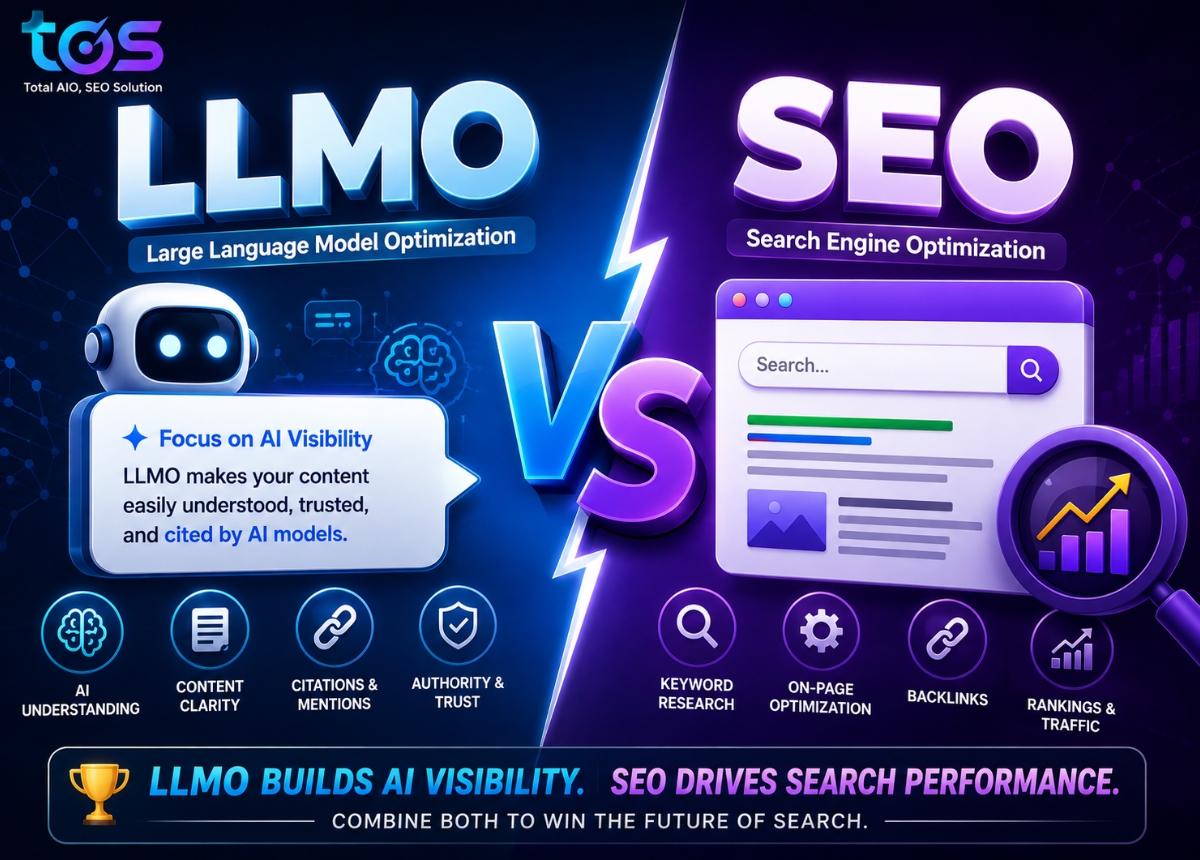
SEO focuses primarily on improving visibility in search results, while AEO focuses on increasing the likelihood that content is used in direct AI-generated answers.
The two strategies overlap heavily.
| Factor | SEO | AEO |
| Primary goal | Improve search visibility | Improve visibility in generated answers |
| Main environment | Search engines | Answer engines and AI search |
| Typical query | Keyword-based | Conversational prompt |
| Main output | Ranked results | Direct answer |
| Key visibility signal | Ranking position | Mention, citation, inclusion |
| Content focus | Relevance and search intent | Answerability and contextual relevance |
| Important foundation | Technical SEO | SEO + structured, answer-ready content |
| Typical measurement | Rankings, clicks, traffic | Mentions, citations, share of voice, AI traffic |
Conductor similarly describes AEO as an extension of SEO rather than a replacement. SEO helps establish discoverability and authority, while AEO adapts content for AI-generated answers.
TOS recommends treating SEO and AEO as one connected search visibility strategy.
AEO vs SEO vs GEO vs AIO: What’s the Difference?
Is AEO the Same as GEO?
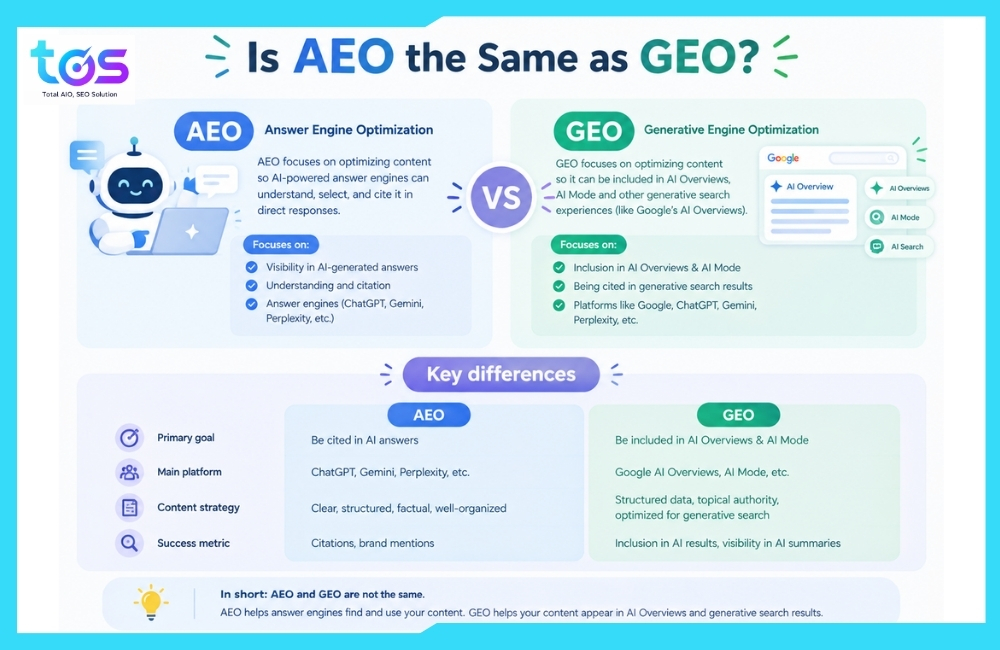
AEO and GEO overlap, but they are not always used to describe exactly the same optimization focus.
AEO traditionally emphasizes becoming a direct answer or cited source in answer engines.
GEO, or Generative Engine Optimization, is a broader term often used for optimizing brand and content visibility across generative AI experiences.
Different companies use these terms differently.
A practical distinction is:
| AEO | GEO |
| Focuses on answers | Focuses on generative AI visibility |
| Strong emphasis on questions | Broader emphasis on prompts and topics |
| Targets answer extraction | Targets mentions, citations, recommendations, and references |
| Often associated with answer engines | Often associated with generative engines |
The terminology is still evolving.
For this reason, marketers should focus less on labels and more on the actual visibility outcome.
The important questions are:
- Does AI understand the brand?
- Does AI mention the brand?
- Does AI cite the website?
- Does AI recommend the product or service?
- Does AI describe the company accurately?
- Which competitors appear instead?
TOS covers the broader concept in its resource on generative engine optimization.
Generative Engine Optimization: A Complete Guide
What Are the Main AEO Ranking or Visibility Factors?
There is no publicly documented universal AEO ranking formula that applies to every answer engine.
ChatGPT, Gemini, Perplexity, Google AI features, and other systems can use different retrieval methods, models, indexes, and ranking processes. Industry guidance therefore focuses on observable content characteristics rather than a fixed ranking formula.
1. Content relevance
The page should directly address the user’s question. A page about “SEO services” should not try to answer every possible marketing question. Topical focus makes the relationship between the content and the query clearer.
2. Direct answers
The main answer should appear early.
- For a definition page, the first paragraph can define the term in one or two sentences.
- For a comparison page, the first paragraph can state the main difference.
- For a tutorial, the first paragraph can summarize the process.
3. Content depth
Short answers can work for simple questions.
Complex topics require enough context to explain:
- Definitions
- Causes
- Processes
- Examples
- Limitations
- Comparisons
- Use cases
- Practical recommendations
Depth should serve the reader rather than target an arbitrary word count.
Google explicitly states that there is no preferred word count for ranking.
4. Original information
Generic summaries are easy to reproduce. Original research, proprietary data, first-hand experience, expert commentary, and unique frameworks provide additional information value.
Google’s current generative AI guidance specifically recommends valuable, non-commodity content with original perspectives and information beyond what can easily be reproduced elsewhere.
5. Authority and trust
AI systems need reliable sources to construct reliable answers.
Useful signals include:
- Expert authors
- Author pages
- References
- Original data
- Consistent facts
- Industry recognition
- Strong topical authority
- Accurate company information
6. Semantic clarity
Content should make relationships between entities clear.
For example:
TOS → AEO service → Answer Engine Optimization → ChatGPT → Gemini → AI visibility
The clearer these relationships are, the easier it becomes to understand what a page is actually about.
7. Technical accessibility
Important information should be accessible to crawlers.
Problems such as:
- noindex
- blocked crawling
- incorrect canonicalization
- broken internal links
- inaccessible content
- poor rendering
can undermine visibility before content quality even becomes relevant.
8. Freshness
Some topics change quickly. AI platforms, search features, regulations, pricing, product specifications, and industry statistics can become outdated. Pages covering fast-moving subjects should display an accurate update date.
How to Optimize Content for AEO
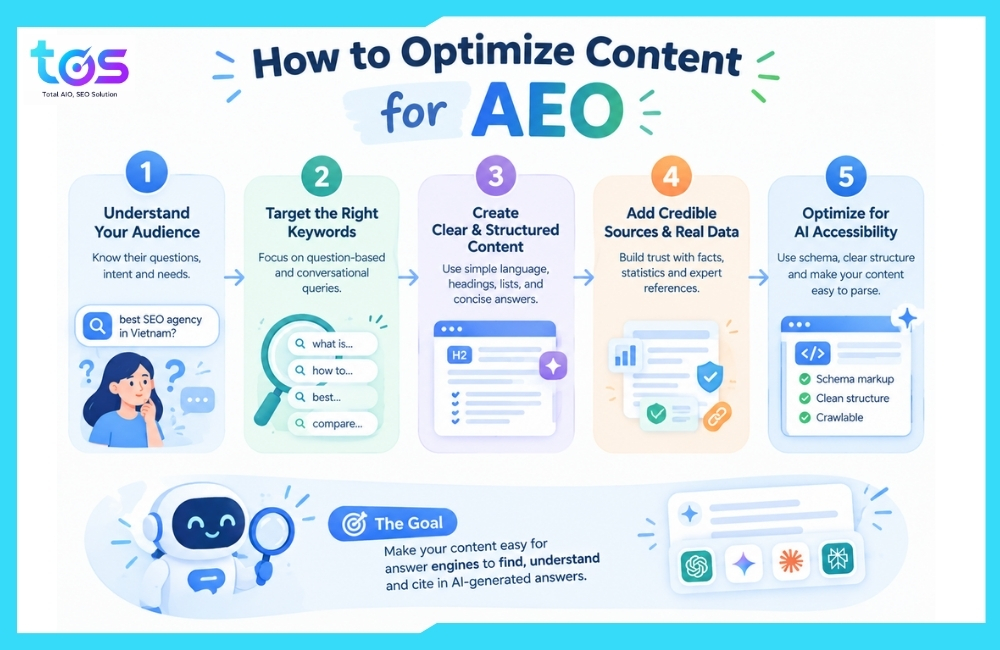
AEO content should answer real questions directly, provide context, demonstrate expertise, and make important information easy to retrieve.
The following framework can help marketers optimize existing content.
Step 1: Identify real user questions
Start with questions instead of keywords alone.
For example, a B2B SEO agency could map questions such as:
- What is SEO?
- How much does SEO cost?
- How long does SEO take?
- Is SEO still effective?
- What is AEO?
- How does AEO differ from SEO?
- How can a brand appear in ChatGPT?
- How can a business improve AI visibility?
These questions can become content clusters.
Step 2: Match content to search intent
Group prompts into intent categories.
| Intent | Example prompt | Recommended content |
| Definition | What is AEO? | Definition guide |
| Comparison | AEO vs SEO | Comparison page |
| How-to | How to optimize for AEO? | Step-by-step guide |
| Recommendation | What is the best AEO agency? | Comparison or service content |
| Commercial | AEO service cost | Service page |
| Evaluation | Does AEO work? | Case study or research |
| Transactional | Hire an AEO agency | Service page |
This approach creates a stronger relationship between content and user needs.
Step 3: Use question-based headings
Use headings that reflect real questions. For example:
Weak: “Introduction”
Better: “What Is AEO?”
Another example:
Weak: “Differences”
Better: “How Is AEO Different From SEO?”
Clear headings help users scan the page.
They also create self-contained content sections.
Step 4: Answer immediately
Place the core answer in the first paragraph. A strong AEO section can follow this structure:
Question → Direct Answer → Explanation → Example → Evidence
This structure works well for informational content.
Step 5: Make each section independently useful
An answer engine may retrieve one passage rather than the entire page.
Each H2 should therefore make sense when separated from the rest of the article. Avoid paragraphs that begin with:
“As mentioned above…”
That sentence loses context when the paragraph is extracted independently. Instead, repeat the essential subject naturally. For example:
“AEO differs from SEO because…”
This sentence remains meaningful by itself.
Step 6: Add tables and lists where they improve comprehension
Tables work well for:
- Comparisons
- Features
- Processes
- Advantages
- Differences
- Evaluation criteria
Lists work well for:
- Steps
- Examples
- Checklists
- Best practices
- Common mistakes
Formatting should support understanding rather than decorate the page.
Step 7: Strengthen internal linking
Connect related pages using descriptive anchor text. For example, an AEO article can link to content about:
- GEO
- AI visibility
- SEO
- AI citations
- AEO audits
The anchor should describe the destination.
Avoid generic anchors such as “click here.”
For TOS, relevant resources include:
Step 8: Strengthen EEAT
EEAT stands for Experience, Expertise, Authoritativeness, and Trustworthiness. For AEO content, practical EEAT signals can include:
- Expert authorship
- First-hand experience
- Original research
- Transparent sources
- Case studies
- Updated information
- Accurate company information
- Relevant industry references
Avoid making unsupported claims.
For example, a statement such as “AEO guarantees a top position in ChatGPT” should not appear. AI-generated answers are dynamic. No responsible AEO strategy can guarantee a specific response from every AI system.
Step 9: Use structured data correctly
Structured data provides explicit information about page content. Google supports formats such as JSON-LD, Microdata, and RDFa, with JSON-LD generally recommended for ease of implementation.
Possible structured data types depend on the actual page. For an informational article, Article may be relevant. For eligible content types, other schema types can apply. However, structured data should accurately represent visible page content.
Google states that structured data does not guarantee a rich result. It only makes a page eligible for certain search features when other requirements are satisfied.
Step 10: Measure AI visibility
AEO cannot be evaluated only through organic rankings. A practical measurement framework can include:
- Brand mentions
- AI citations
- Citation URLs
- Share of voice
- Prompt coverage
- Competitor mentions
- AI referral traffic
- Accuracy of brand information
- Recommendation frequency
The exact metrics depend on the AI platforms being monitored.
What Is an AEO Strategy?
An AEO strategy is a structured plan for increasing a brand’s visibility, accuracy, and citation potential across AI-powered answer experiences.
A complete strategy usually combines four layers.
Layer 1: Technical foundation
Start with the website. Check:
- Crawlability
- Indexability
- Canonicals
- Internal links
- Page rendering
- Structured data
- Site architecture
- Page speed
- Content accessibility
Technical issues can prevent high-quality content from being discovered.
Layer 2: Content optimization
Next, optimize the content itself. Prioritize:
- Direct answers
- Question-based headings
- Clear definitions
- Short answer blocks
- Supporting evidence
- Tables
- Lists
- Examples
- Original insights
- Semantic relationships
Layer 3: Entity and authority optimization
AI systems need context about brands and entities. Build consistent information across:
- Website
- Author pages
- Company profiles
- Industry publications
- Review platforms
- Social profiles
- Relevant third-party sources
The objective is not to create artificial mentions. The objective is to establish a consistent and trustworthy representation of the brand.
Layer 4: AI visibility monitoring
Monitor how AI systems represent the brand. For example:
Prompt: “Best SEO agencies in Vietnam”
Track:
- Does the brand appear?
- Which competitors appear?
- Is the brand description accurate?
- Which sources are cited?
- Which pages are cited?
- How often does the brand appear?
This creates an actionable AEO feedback loop.
AEO Example: How a Brand Can Optimize One Page
Consider a fictional software company called ExampleCRM.
The company wants to appear when users ask:
“What is the best CRM for a small B2B sales team?”
A traditional SEO approach might create a page targeting:
Best CRM for small business
An AEO-oriented approach would expand the information architecture.
Primary question
What is the best CRM for a small B2B sales team?
Supporting questions
- What should a small B2B team look for in a CRM?
- How much does CRM software cost?
- Which CRM features matter most?
- What is the difference between CRM and marketing automation?
- What CRM works for a five-person sales team?
- How should businesses compare CRM platforms?
The page can then provide:
- A direct answer.
- Evaluation criteria.
- A comparison table.
- Product strengths.
- Limitations.
- Pricing information.
- Customer examples.
- Expert commentary.
- Supporting evidence.
- Frequently asked questions.
The goal is not to repeat “best CRM” hundreds of times. The goal is to become a useful source for the entire decision context.
What Is the Difference Between AEO and Traditional Featured Snippet Optimization?
Featured snippet optimization targets specific search result formats, while AEO addresses a broader set of AI-generated answer experiences.
Featured snippets are part of traditional search.
AEO can involve:
- AI-generated answers
- Conversational search
- AI assistants
- Voice interfaces
- AI search summaries
- Featured snippets
- Other answer-oriented experiences
The underlying principle is similar. Both approaches benefit from concise, direct, well-structured answers.
The difference is scope.
A featured snippet usually presents a selected passage from a webpage.
An AI answer can synthesize information from multiple sources.
That makes source authority, contextual relevance, entity relationships, and information consistency more important in broader AEO strategies.
Can AEO Replace SEO?
AEO should not replace SEO because technical SEO and organic search remain important foundations for AI-powered discovery.
Google states that its existing SEO best practices remain relevant to AI Overviews and AI Mode. Pages also need to be indexed and eligible for normal Search to qualify as supporting links in these AI experiences.
A better model is:
SEO + AEO + Content + Entity + Authority + Measurement
SEO helps establish:
- Discoverability
- Technical accessibility
- Organic rankings
- Topical relevance
- Website authority
AEO extends that foundation toward:
- AI mentions
- AI citations
- AI recommendations
- Conversational discovery
- Generative search visibility
Businesses should therefore avoid treating AEO as a separate replacement channel.
The stronger approach is an integrated search strategy.
What Are Common AEO Mistakes?
The most common AEO mistakes include keyword stuffing, publishing generic AI-generated content, using unsupported statistics, relying too heavily on structured data, and measuring success only through traditional SEO rankings. These practices can limit content quality, reduce trust, and make it harder for AI-powered search systems to understand and confidently use your information.
1. Keyword stuffing
Repeating the same keyword excessively does not make content more likely to appear in AI-generated answers. Instead, focus on answering the user’s question naturally and covering related concepts.
- Use the primary keyword naturally throughout the content.
- Include relevant synonyms and related entities.
- Prioritize search intent and topical relevance over keyword density.
- Avoid inserting keywords where they make the sentence unnatural.
- Write for users first rather than trying to manipulate AI systems.
2. Writing only for AI
AEO content should still provide a useful experience for human readers. Content created primarily to influence search or AI systems can become repetitive, generic, or difficult to read.
- Start with the user’s actual question or problem.
- Provide a direct answer before the detailed explanation.
- Use clear headings, short paragraphs, tables, and lists where appropriate.
- Add examples, expert insights, and original information.
- Make sure the content remains useful even without AI-generated search features.
3. Creating generic AI summaries
Using AI to assist with content creation is not inherently a problem. The issue is publishing content that simply summarizes information already available elsewhere without adding meaningful value.
- Review and fact-check AI-generated information before publishing.
- Add first-hand experience, expert opinions, or original insights.
- Include relevant examples that are specific to your audience or industry.
- Remove repetitive or unnecessary information.
- Cite reliable sources for important claims and statistics.
- Ensure the final content reflects genuine expertise rather than simply paraphrasing existing articles.
4. Using unsupported statistics
Statistics can strengthen an article, but inaccurate, outdated, or unsupported data can damage credibility and trust.
- Verify every external statistic with a reliable and authoritative source.
- Avoid using statistics without a clear source or publication date.
- Update time-sensitive data when the information may have changed.
- Prioritize first-party data or reputable industry research when available.
- Do not use statistics simply because they make an article appear more authoritative.
5. Treating schema as an AEO shortcut
Structured data helps search engines understand the content and context of a webpage, but it does not guarantee AI citations, rankings, or search features.
- Use structured data that accurately represents the visible content on the page.
- Choose the appropriate Schema type based on the page’s actual content and purpose.
- Keep structured data technically valid and consistent with Google’s guidelines.
- Do not rely on Schema alone to improve AEO or AI visibility.
- Combine structured data with high-quality content, technical SEO, clear information architecture, internal linking, and trust signals.
- Remember that Google states valid structured data does not guarantee a rich result.
6. Ignoring technical accessibility
Even high-quality content may struggle to gain visibility if search engines cannot properly access, crawl, or index the page.
Common technical issues include:
- Pages accidentally marked with noindex.
- Incorrect canonical URLs.
- Blocked crawling.
- Broken internal links.
- Important content hidden from crawlers.
- Incorrect or incomplete structured data.
- Poor website architecture.
- Slow or unstable page performance.
Before optimizing content for AEO, make sure the underlying website provides a strong technical foundation.
7. Creating answers without context
A short answer can be useful, but an answer without supporting context may not provide enough information for complex queries.
For example, simply stating:
“AEO means Answer Engine Optimization.”
answers the definition but does not explain:
- What AEO does.
- How AEO works.
- Why it matters.
- How it differs from SEO.
- How businesses can implement it.
A stronger AEO section should follow the structure:
Direct answer → Explanation → Example → Supporting evidence → Practical takeaway
This gives both users and AI systems enough context to understand the topic.
8. Ignoring brand and entity signals
AI systems may use information from multiple sources when generating answers about a company, product, or person.
If brand information is inconsistent across the web, it can become harder for AI systems to establish a clear understanding of the entity.
Check whether your:
- Brand name is consistent.
- Company description is accurate.
- Products or services are clearly defined.
- Authors and experts are identifiable.
- Website information matches credible third-party sources.
- Important brand entities are clearly connected.
Building consistent entity signals can help establish a clearer digital footprint.
9. Measuring AEO only through Google rankings
Traditional SEO metrics remain important, but rankings alone cannot show how a brand performs across AI-generated answers.
An AEO measurement framework should also consider:
- AI mentions: How often the brand appears in AI responses.
- AI citations: How often the website is referenced as a source.
- Prompt visibility: How frequently the brand appears for target prompts.
- Share of voice: How the brand’s AI visibility compares with competitors.
- Citation quality: Which pages and sources AI systems reference.
- Brand accuracy: Whether AI platforms describe the brand correctly.
- AI referral traffic: Visits generated from AI platforms.
- Conversions: Whether AI-driven visibility contributes to business results.
The goal is not simply to appear more often. The goal is to be accurately represented and referenced in relevant AI-generated answers.
10. Chasing every new AI platform
AI search is evolving quickly, but businesses do not necessarily need to optimize for every platform simultaneously.
Instead:
- Identify where your target audience searches for information.
- Prioritize the AI platforms relevant to your industry.
- Track the prompts that influence your customers’ decisions.
- Compare your visibility against key competitors.
- Adjust the strategy based on measurable results.
A focused AEO strategy is generally more actionable than trying to optimize for every emerging AI platform at once.
How Can You Measure AEO Success?
AEO success should be measured through AI visibility, citations, brand mentions, competitive share of voice, and business outcomes.
A useful measurement framework can look like this:
| Metric | What it measures |
| AI visibility | How often the brand appears in tracked AI responses |
| Mention rate | How frequently the brand is mentioned |
| Citation rate | How frequently the website is cited |
| Citation quality | Whether authoritative pages are being cited |
| Share of voice | Brand visibility compared with competitors |
| Prompt coverage | Percentage of target prompts where the brand appears |
| Brand accuracy | Whether AI describes the company correctly |
| AI referral traffic | Visitors arriving from AI platforms |
| Conversion rate | Business value generated from AI traffic |
A single metric should not determine success.
For example, more mentions do not automatically mean better visibility if the AI describes the brand incorrectly.
A high-quality AEO program should improve both visibility and accuracy.
How Long Does AEO Take to Work?
AEO does not have a universal implementation timeline because results depend on the website, brand authority, content quality, competition, platform, and tracked prompts.
AI systems can also change their retrieval and generation behavior over time.
TOS currently states that its AEO projects commonly require around 1–3 months after AEO elements are standardized, depending on brand coverage and changes in AI platforms. This is a TOS service estimate, not a guaranteed industry-wide timeframe.
A realistic implementation can include:
Month 1: Audit and research
- AI visibility audit
- Prompt research
- Competitor analysis
- Content gap analysis
- Entity review
- Technical assessment
Month 2: Optimization
- Content restructuring
- On-page optimization
- Entity improvements
- Internal linking
- Structured data
- Trust signals
Month 3: Monitoring and iteration
- Prompt monitoring
- Citation analysis
- Competitor tracking
- Content refinement
- AI visibility reporting
The exact timeline should be determined after auditing the website.
How Can a Business Start AEO?
The fastest practical starting point is to identify important customer prompts, check current AI visibility, and improve the pages that answer those prompts.
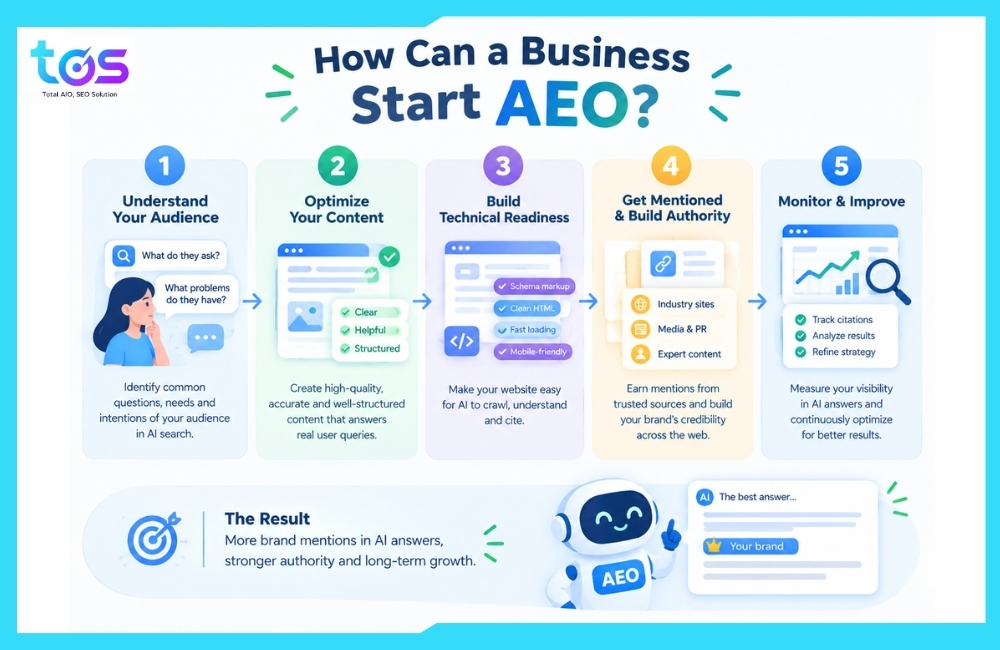
A simple starting workflow is:
Step 1: List 20–50 customer questions
Focus on questions related to:
- Products
- Services
- Problems
- Comparisons
- Pricing
- Recommendations
- Industry topics
Step 2: Test those prompts across AI platforms
Check relevant platforms such as:
- ChatGPT
- Gemini
- Perplexity
- Google AI search experiences
Record the results.
Step 3: Build a competitor visibility map
Track:
- Your brand
- Direct competitors
- Frequently cited sources
- Frequently mentioned brands
- Citation URLs
Step 4: Identify content gaps
Look for questions where competitors appear but your brand does not.
Then determine whether the gap comes from:
- Missing content
- Weak content
- Poor structure
- Low authority
- Weak entity signals
- Technical accessibility
- Lack of supporting evidence
Step 5: Optimize the highest-value pages
Prioritize pages connected to revenue.
For example:
Commercial prompt → Service page → Supporting article → Case study → Brand authority
This creates a stronger content ecosystem than optimizing isolated blog posts.
How TOS Helps Businesses With AEO
TOS provides GEO/AEO services designed to improve how brands appear, are understood, and are referenced across AI-powered search experiences.
The TOS AEO service combines research, auditing, content optimization, authority building, and AI visibility monitoring.
The service currently includes areas such as:
- ChatGPT visibility auditing
- Gemini visibility auditing
- Search intent research for AI platforms
- AEO strategy development
- On-page optimization
- E-E-A-T and trust signal optimization
- Entity optimization
- Structured data
- AI visibility monitoring
- Reporting and continuous optimization
TOS’s implementation process follows five major stages:
Requirement collection → Deep analysis → Strategy development → Implementation → Reporting and maintenance
This process allows AEO work to connect with the existing SEO and content ecosystem instead of operating as an isolated campaign.
Why choose TOS for AEO?
TOS approaches AEO from a broader Search AI perspective.
The objective is not simply to insert question headings into articles.
The strategy considers:
- User prompts
- Search intent
- Content structure
- Technical SEO
- Entity relationships
- E-E-A-T
- Internal linking
- Structured data
- AI citations
- Competitor visibility
- Brand accuracy
TOS also positions AEO alongside GEO, AIO, and SEO as part of a broader Search AI strategy.
Businesses looking to increase visibility across ChatGPT, Gemini, and other AI search experiences can start with an AEO audit before committing to a larger optimization roadmap. Contact TOS for an AEO consultation and receive a strategy based on the website’s current AI visibility, target prompts, competitors, and business goals.
AEO Checklist: 15 Things to Check
Before publishing or optimizing a page for AEO, use this checklist.
- Does the page answer the primary question immediately?
- Does the first paragraph contain a concise definition?
- Does every H2 address a clear user intent?
- Does the first sentence of each section answer the heading?
- Are important questions represented as headings?
- Are explanations supported by examples?
- Are external statistics properly sourced?
- Does the content include original information?
- Are author and expert signals clear?
- Are important entities clearly defined?
- Are internal links contextually relevant?
- Is structured data accurate and visible in the page content?
- Can search engines crawl and index the page?
- Is the content updated when facts change?
- Is AI visibility being monitored after publication?
AEO should be treated as an ongoing optimization process.
A page can be technically excellent today and still require updates as search behavior, competitors, and AI systems evolve.
Frequently Asked Questions About AEO
What does AEO stand for?
AEO stands for Answer Engine Optimization. It refers to optimizing content so answer engines can understand, extract, and use it when generating direct answers to user questions.
What is AEO in simple terms?
AEO is the practice of making website content easier for AI-powered answer engines to understand and cite. SEO helps a page appear in search results, while AEO focuses more on being included in AI-generated answers.
Is AEO the same as SEO?
No. AEO and SEO overlap but have different primary outcomes. SEO focuses on organic search visibility, while AEO focuses on visibility inside AI-generated answers, mentions, and citations.
Does AEO replace SEO?
No. AEO should complement SEO. Google states that existing SEO fundamentals remain relevant for AI Overviews and AI Mode, and pages still need to meet normal Search eligibility requirements.
How do I optimize my website for AEO?
Start by identifying important customer questions, creating direct answers, improving content structure, strengthening authority signals, using accurate structured data, improving technical accessibility, and monitoring AI visibility.
Can AEO guarantee that ChatGPT will mention my brand?
No. AEO cannot guarantee a specific AI response. AI-generated answers can vary by platform, query, context, model, retrieval sources, and system updates.
Final Takeaway: What Is AEO?
AEO, or Answer Engine Optimization, is the practice of optimizing content so AI-powered answer engines can understand, trust, extract, and cite it in generated responses.
The biggest difference from traditional SEO is the visibility target.
SEO asks:
“How can this page rank higher?”
AEO adds another question:
“How can this information become part of the answer?”
The strongest strategy does not choose between the two.
It combines:
Technical SEO + Helpful Content + Search Intent + Entity Optimization + EEAT + AEO + AI Visibility Measurement
Google’s current guidance reinforces this direction. There is no secret technical “AEO hack” required for Google AI features. Strong SEO fundamentals, useful original content, technical accessibility, and a people-first approach remain central.
For businesses, the opportunity is broader than gaining another ranking.
The goal is to become a trusted source that AI systems can confidently use when customers ask questions about the category, problem, product, or brand.
TOS helps businesses build that visibility through a structured GEO/AEO strategy across content, technical SEO, entities, trust signals, and AI visibility monitoring.
 TOS · Search AI Agency
Get fresh SEO & AI insights — every day
Curated, practical, no spam. Join marketers who read TOS first.