




LLMO (Large Language Model Optimization) is the practice of shaping your content so large language models such as ChatGPT, Claude, and Gemini can understand it, trust it, and cite it when they answer real questions. As buyers increasingly ask an AI assistant instead of scrolling a results page, being the source the model quotes has become a new front line for brand visibility. This guide explains what LLMO is, how it works, how it differs from classic SEO, and how to put it into practice – plus how TOS runs LLMO for the Vietnamese and bilingual market.
What is LLMO?
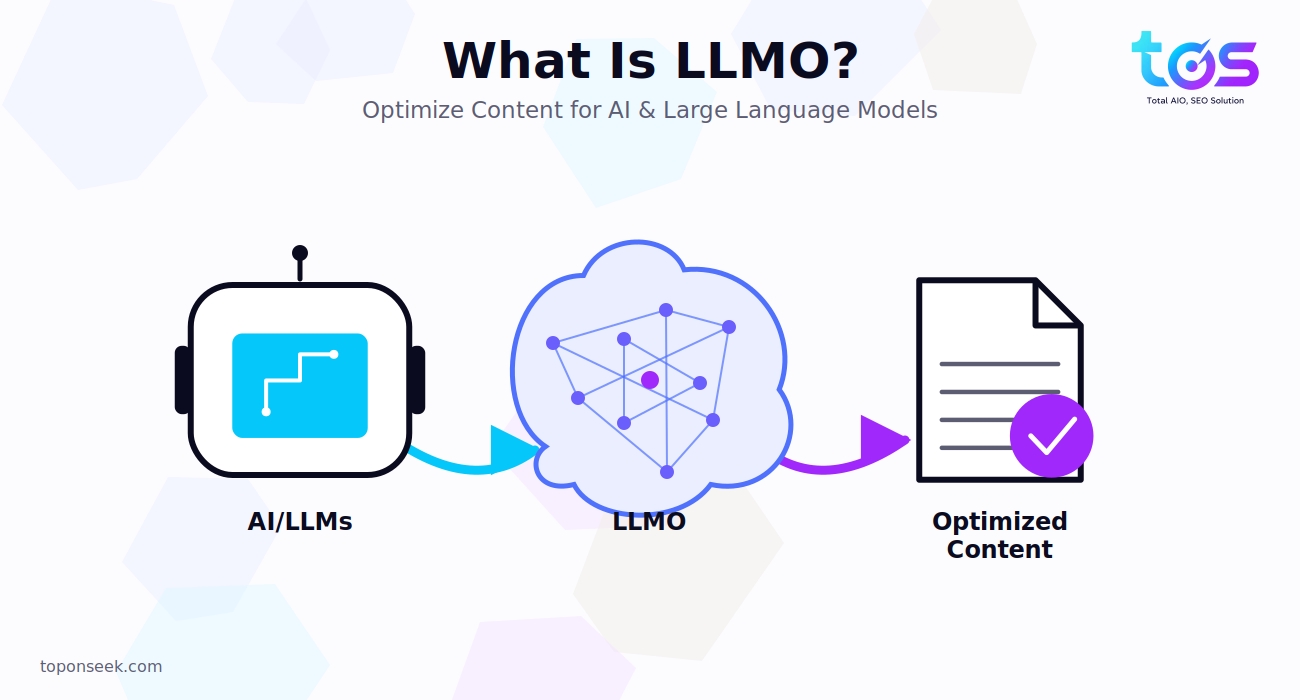
LLMO, or Large Language Model Optimization, is the discipline of writing and structuring content so AI systems can accurately extract, reuse, and attribute it inside their generated answers. Instead of chasing a blue-link ranking, LLMO aims to make your brand the trusted reference a model reaches for when a user asks a question in ChatGPT, Google’s AI Overviews, Perplexity, Microsoft Copilot, or Anthropic’s Claude.
The shift matters because the buyer journey is changing shape. A prospect who once typed a keyword and compared ten links now asks a conversational assistant for a recommendation and often acts on a single synthesized answer. In that moment there is no results page to climb, there is only the question of whether the model already knows you, understands what you do, and considers you credible enough to name. LLMO is the work that makes the answer “yes.”
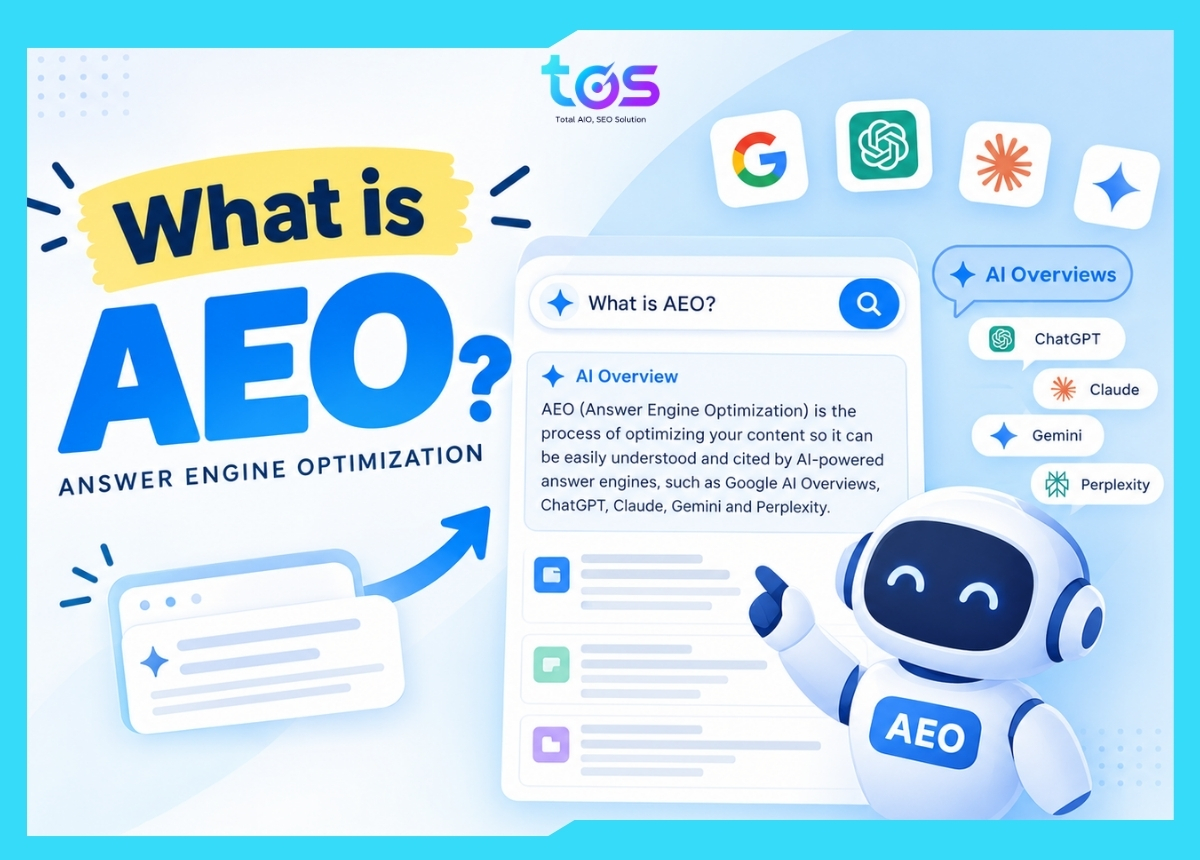
In practice, LLMO overlaps heavily with Generative Engine Optimization (GEO). As of early 2026 there is no settled academic distinction between LLMO, GEO, Answer Engine Optimization (AEO), and AI Optimization (AIO). The terms are used interchangeably across the industry. The nuance many practitioners draw is that LLMO puts the emphasis on the underlying language models themselves, rather than on any single AI search product built on top of them.
How LLMO works: the key elements
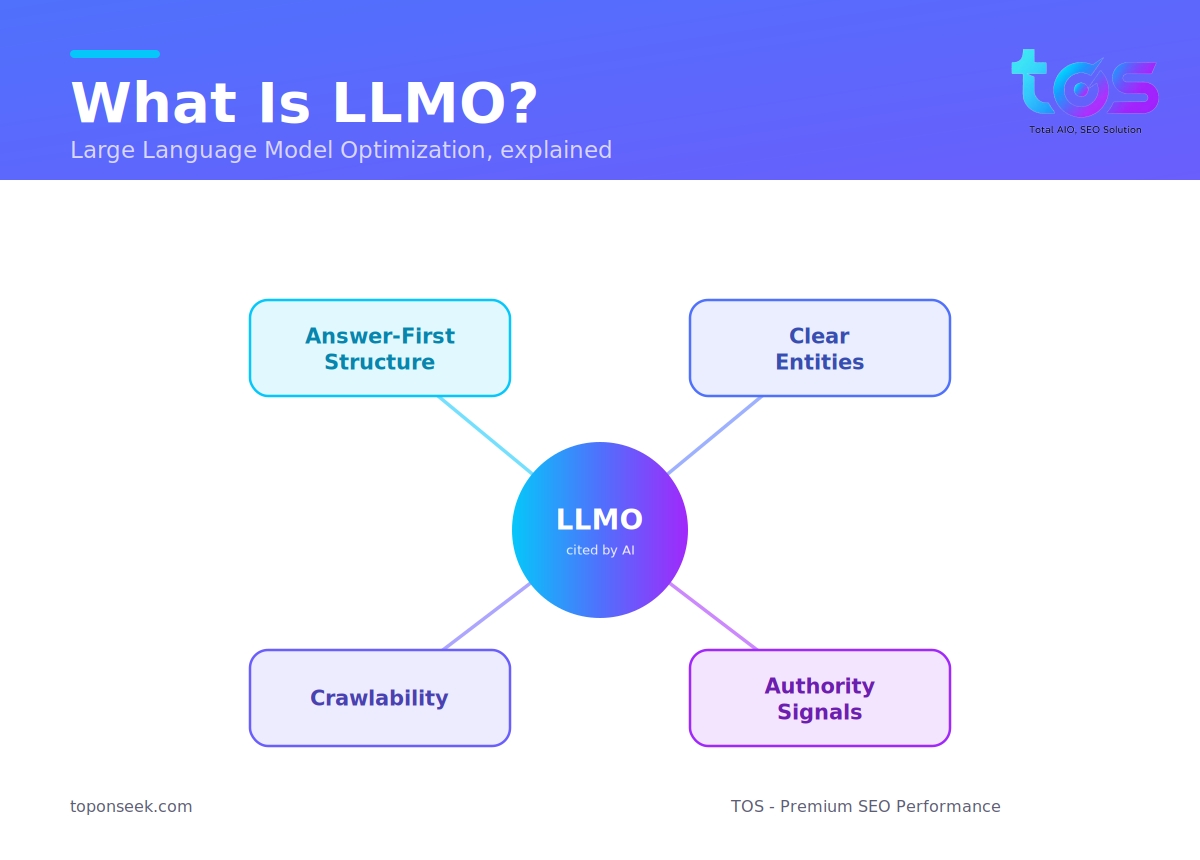
Large language models do not “rank” pages the way a search engine does. They retrieve, read, and synthesize information, then generate an answer and sometimes cite the sources behind it. Many assistants now sit on top of a retrieval layer that pulls fresh passages from the web at answer time, so your goal is twofold: be retrievable when the model looks, and be safe to quote once it reads you. Good LLMO makes your content easy to retrieve and easy to trust. The core elements are:
- Answer-first structure: lead each section with a clear, standalone statement a model can lift verbatim, then support it with detail. A passage that answers the question in its first sentence is far easier to quote than one that buries the point in paragraph four.
- Clear entities and consistency: use consistent names for your brand, products, and people so models can build a reliable picture of who you are across the web. Ambiguity – three spellings of a product name, a founder listed under two titles – dilutes the model’s confidence in you.
- Factual density: concrete facts, definitions, figures, and examples give a model something specific to cite instead of vague marketing language. “Fast, reliable, industry-leading” is unquotable; a defined process or a dated fact is not.
- Structured data and semantic headings: schema markup, descriptive H2/H3 headings, tables, and lists help models parse meaning and pull the right passage. Question-style headings that mirror how people actually ask work especially well.
- Authority and trust signals: author credentials, citations to primary sources, and cross-source brand consistency raise the odds a model treats you as credible rather than as one anonymous page among millions.
- Crawlability: if AI crawlers cannot reach or render your page, none of the above matters – technical access remains foundational. Confirm robots.txt allows the crawlers these assistants rely on – OAI-SearchBot and GPTBot for ChatGPT, ClaudeBot for Claude, PerplexityBot for Perplexity, Google-Extended for Gemini, and Googlebot for AI Overviews – and that key pages render without depending on client-side JavaScript.
These elements reinforce one another. Answer-first writing gives the model a clean sentence to lift; entities and schema tell it who that sentence belongs to; authority signals decide whether it trusts the claim enough to repeat it. Weak on any one of them and you become harder to cite, even if the rest is strong.
LLMO vs SEO
LLMO does not replace SEO – it extends it. Classic SEO earns clicks from a ranked list of links; LLMO earns citations and mentions inside an AI-generated answer, where the user may never visit your site at all. The two share foundations like quality content and technical health, but they optimize toward different outcomes, and they are measured in different ways.
| Aspect | Traditional SEO | LLMO |
| Goal | Rank in the list of links | Be understood and cited in AI answers |
| Surface | Search results page | ChatGPT, Claude, Gemini, AI Overviews |
| Success metric | Rankings, clicks, traffic | Citations, mentions, share of AI answers |
| Content focus | Keywords and links | Meaning, structure, and trust |
| Ranking logic | Relevance and link authority | Retrieval, synthesis, and citation-worthiness |
| User action | Clicks through to your page | Often reads the answer without clicking |
The practical takeaway is not to pick one. A page that is well-optimized for search – clean structure, strong topical authority, healthy crawlability – is already a good starting point for LLMO. The additional work is making that same page quotable: tightening the opening sentence of each section, sharpening definitions, and making sure the model can tell exactly who is making the claim.
LLMO vs GEO vs AEO: How the Terms Actually Differ
TOS treats LLMO, GEO, and AEO as heavily overlapping practices – the earlier section on this page covers where they converge. Outside TOS, definitions vary, and even industry sources disagree on which term is the umbrella and which is the subset:
- Some treat GEO as the umbrella. In this view, GEO covers all generative search surfaces, and LLMO is the technical and editorial foundation underneath it – the entity work and content structure that make GEO possible.
- Some treat LLMO as the umbrella. In this view, LLMO covers a brand’s presence across every AI system a model powers, while GEO narrows in specifically on Google’s AI Overviews and AI Mode inside search results.
- Some split by surface, not scope. Under this reading, GEO targets AI features that still sit inside a search engine, while LLMO targets standalone assistants – ChatGPT, Claude, Perplexity – where no search results page exists at all.
The disagreement is mostly semantic, not practical. Every reading points to the same underlying work: answer-first content, clean entities, and earned authority. TOS uses LLMO and GEO interchangeably in client conversations for that reason, and reserves the distinction only for teams that need to report on Google’s AI features separately from other assistants.
Why LLMO matters now
The reason to start now, rather than wait for the space to settle, is that AI answers compress the shortlist. A search results page shows a buyer many options; a generative answer often names a few, sometimes one. If a model does not already understand and trust your brand, you are simply absent from that answer and the buyer may never know you existed. Being cited early, while categories are still being defined in the models’ training and retrieval data, is a durable advantage that is hard for a latecomer to unwind.
The shift already shows up in the data. Organic click-through rates fell 61% on informational queries where AI Overviews appear, and still dropped 41% on queries where they do not, according to Seer Interactive’s analysis of more than 3,100 queries across 42 organizations. Google’s own share of the search market slipped below 90% in October 2024, a first since 2015. Traffic arriving from generative AI sources to US retail sites grew over 1,200% year-over-year by early 2025, per Adobe’s data, and visitors who arrive this way convert roughly 4.4 times better than typical organic traffic, according to Semrush research cited by Search Engine Land. The audience has not shrunk. It has moved to a channel most brands have not optimized for yet.
Check how ready your website is for AI answers. The free TOS AI Visibility Checker scores the on-site signals that affect how likely ChatGPT, Gemini, and Perplexity are to read, understand, and cite your pages.
Run the free AI Visibility Checker
How to get started with LLMO
You do not need to rebuild your site to begin. A practical LLMO rollout moves from measurement to structure to authority:
- Measure your baseline. Ask the major models real buyer questions in your category and record whether and how your brand appears. Combine three sources for this: manual prompts across ChatGPT, Gemini, and Perplexity; referral traffic from AI platforms in GA4; and branded-query volume in Google Search Console. This is your starting share of AI answers, and it tells you which questions you already win and which you are invisible for.
- Rewrite for extraction. Add answer-first summaries, question-style headings, and clean tables so each key point stands on its own. Prioritize your highest-intent pages first – the ones tied to how buyers actually decide.
- Strengthen entities and schema. Standardize brand and product names, add structured data, and connect your content to authoritative references so a model can place you confidently.
- Build cross-source trust. Keep your facts consistent across your site, profiles, and third-party mentions so models see one coherent story instead of conflicting fragments.
- Monitor and iterate. Re-check AI answers regularly; LLMO is an ongoing practice, not a one-time fix, because models refresh their sources and competitors keep publishing.
Treat these as a loop rather than a checklist. Each round of measurement shows which questions still leave you out of the answer, and that gap list becomes the brief for the next round of rewriting and entity work.
LLMO Tools: What to Use for Tracking and Implementation
LLMO has no rankings dashboard to check each morning, so tracking depends on combining a few tool categories rather than one platform:
| Category | What it does | Examples |
| AI-visibility trackers | Query multiple models on a schedule and report when and how your brand is mentioned or cited | Profound, OtterlyAI, Semrush AI Toolkit |
| Referral analytics | Isolate traffic arriving from AI platforms inside your existing analytics | GA4 referral tracking, Google Search Console branded-query volume |
| Crawler-access checkers | Confirm AI bots can actually reach and render your pages | Server log analysis for GPTBot/ClaudeBot/PerplexityBot, Google Search Console URL inspection |
| LLM observability | Monitor how your own AI-powered product features perform in production, if you run any | Langfuse, Helicone |
None of these tools change what a model already believes about your brand overnight. A large language model’s training data can only be influenced at a scale almost no company can reach – the realistic lever is what these tools measure: the live web content a model retrieves at answer time. That is what LLMO actually optimizes.
Disclosure: TOS has been an OtterlyAI Agency Partner since October 2026.
How TOS approaches LLMO (and what makes it different)
At TOS, the main practical problem is running LLMO for a market that is largely bilingual: Vietnamese buyers ask assistants in Vietnamese, in English, and often in a mix of both, and the models draw on very different amounts of source material in each language. TOS treats that as a design constraint, not an afterthought, and builds answer-first passages and consistent entities in Vietnamese and English in parallel, so a model can find and trust the same claim about your brand whichever language the question arrives in – rather than seeing a rich English footprint and a thin Vietnamese one that undercuts its confidence.
From there TOS works in stages: measure where a brand stands across generative engines, score the site’s GEO signals with the TOS AI Visibility Checker, rewrite the highest-intent pages for extraction, standardize entities and schema, and re-measure to see which answers actually moved. One practical caution is that citation is uneven across languages and across engines – a brand can be quoted confidently in one assistant and absent in another. TOS plans for that gap explicitly instead of assuming a single fix carries everywhere, and keeps the Vietnamese and English footprints aligned so trust signals reinforce each other rather than compete.
Frequently asked questions
1. Is LLMO the same as GEO?
They overlap almost entirely. LLMO and GEO both aim to make content visible in AI-generated answers; LLMO simply emphasizes the language models themselves. As of early 2026 the industry uses the terms, along with AEO and AIO, interchangeably.
2. Does LLMO replace traditional SEO?
No. LLMO builds on SEO fundamentals like quality content and technical health, then optimizes toward citations in AI answers rather than only rankings. Most brands should run both together.
3. How do I know if an AI model cites my content?
Ask the major models common questions in your category and note when your brand is mentioned or linked. Tracking this over time, or using an AI-visibility tool, gives you a measurable baseline for LLMO.
4. How long does LLMO take to show results?
It varies with your starting authority and how often models refresh their sources. Structural fixes can influence answers within weeks, while entity and trust signals compound over months of consistent effort.
5. Does LLMO work for non-English and bilingual content?
Yes, but results are uneven by language. Models have far more source material in some languages than others, so a brand can be well cited in English yet absent in Vietnamese. The fix is to build answer-first content and consistent entities in each language you serve, rather than assuming an English footprint carries over.
6. Which pages should I optimize for LLMO first?
Start with your highest-intent pages – the ones tied to how buyers compare and decide and the questions where you are currently invisible in AI answers. Fixing those first moves the metric that matters; then you can extend the same approach across the rest of the site.
7. What tools should I use to track LLMO?
Combine an AI-visibility tracker (Profound, OtterlyAI, or Semrush’s AI Toolkit) with referral tracking already available in GA4 and Google Search Console. The tracker tells you when models mention you; analytics tells you what happens after.
8. Do I need an llms.txt file for LLMO?
No major model currently requires it, and Google has said explicitly that it has no effect on inclusion in AI Overviews. Some LLMO checklists still recommend it as a low-cost signal of intent, but crawlability, structure, and authority carry far more weight.
References
- Search Engine Land – What is LLMO? Optimize content for AI & large language models
- Wikipedia – Generative Engine Optimization
LLMO is how modern brands stay visible when buyers ask AI instead of searching. TOS helps brands make their content easier for ChatGPT, Claude, and Gemini to understand, trust, and cite – starting with the free TOS AI Visibility Checker, which scores the on-site signals behind AI citation, then building an answer-first, bilingual LLMO plan around the gaps it surfaces.
 TOS · Search AI Agency
Get fresh SEO & AI insights — every day
Curated, practical, no spam. Join marketers who read TOS first.