

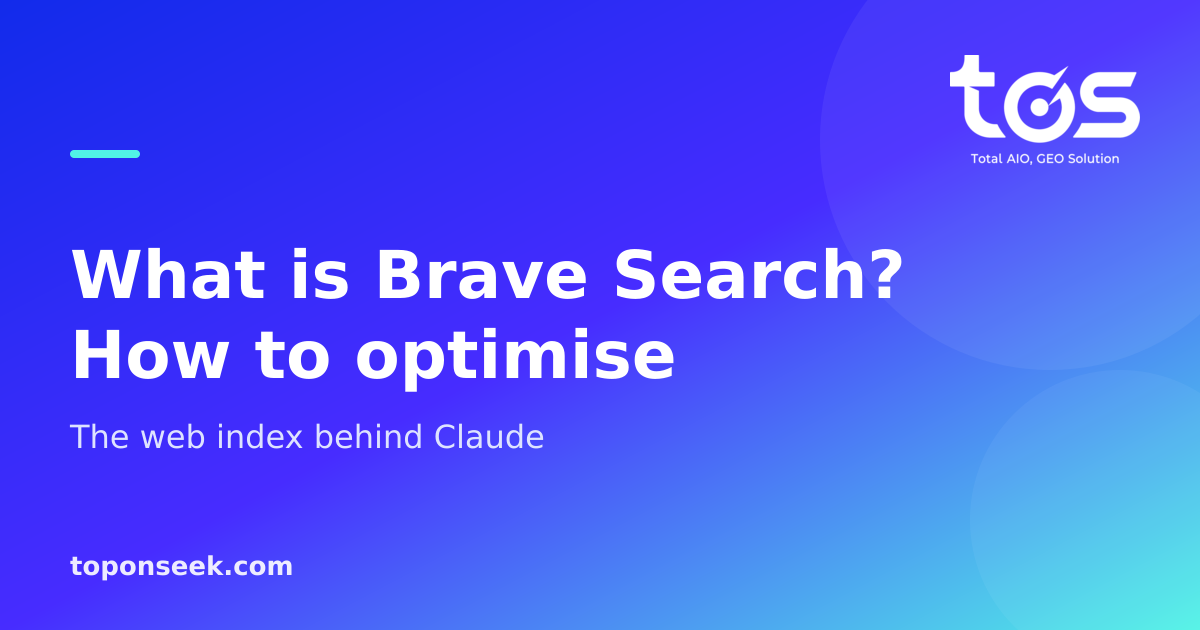



Brave Search is a search engine running on its own index, built from scratch rather than borrowed from Google or Bing. For SEO teams the reason to care sits elsewhere: Anthropic lists Brave Search as a web search provider for Claude. When Claude searches the web to answer a question, the results pass through Brave’s index. Optimising for Brave Search is therefore the most direct route to getting a website cited by Claude.
This article covers how Brave Search works, one technical detail that makes optimising for Brave unlike any other engine, and the work that follows from it.
What is Brave Search?
Brave Search is the search engine from Brave Software, set as the default for anyone who downloaded the Brave browser on or after 19 October 2021. What separates it from most alternative engines is that Brave runs on an index it built from scratch, instead of reselling results from a Google or Bing API the way many services still do.
That index is fed from two directions: Brave’s own crawler, and the Web Discovery Project, a mechanism letting Brave browser users contribute anonymised browsing data. Brave states clearly that this is off by default and must be switched on by the user.
Why Brave Search connects directly to Claude
In the public subprocessor list on its Trust Center, Anthropic names Brave Search with the purpose “Web Search”, scoped to all products. The same purpose also covers TurboPuffer, scoped to all products except Claude for Government.
That second entry is worth noting because most guidance on optimising for AI mentions Brave and stops there. In practice Claude does not pull from a single source, so appearing in Brave Search raises the odds of being cited without guaranteeing it.
It is also why the TOS checker files anything Brave-related under “TOS cannot verify this from the outside”: no public API exists for checking whether a given website sits in Brave’s index.
The detail that matters most: Brave has no distinct user agent
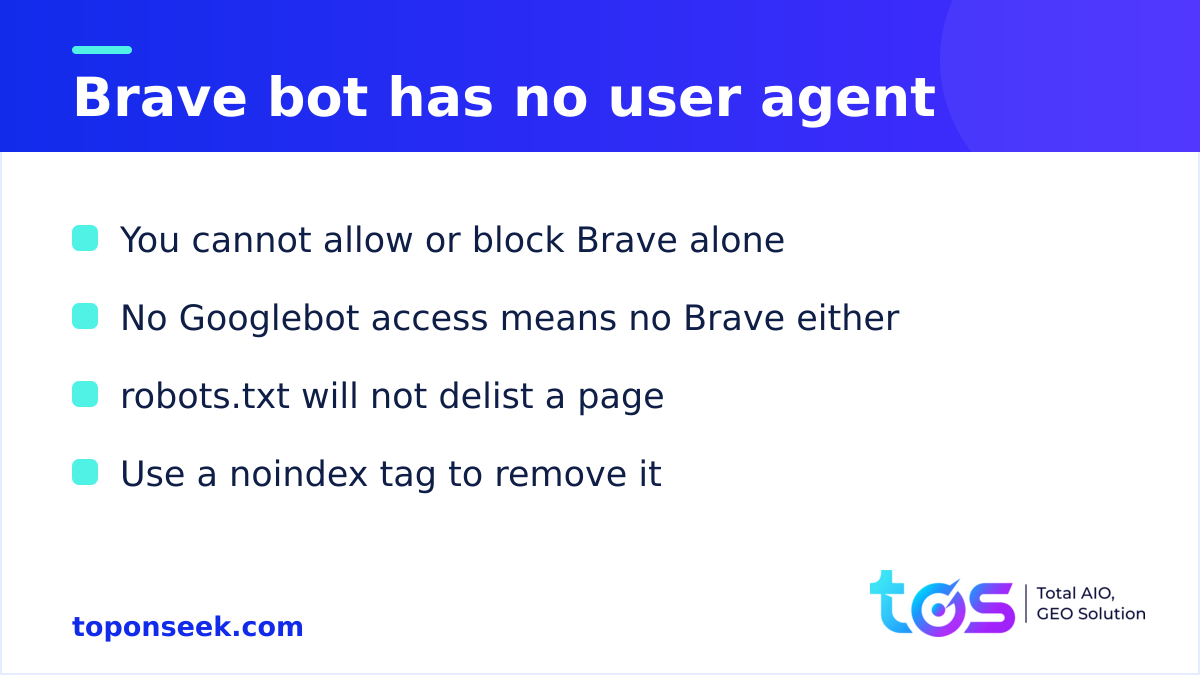
This is where SEO teams get it wrong. Brave’s bot deliberately does not advertise a distinct user agent. Brave explains why in its documentation for site owners: it avoids being discriminated against by sites that let only Google crawl them.
From that follows the key rule Brave publishes itself: if a domain or page is not crawlable by Googlebot, then Brave Search’s bot will not crawl it either.
Three practical consequences:
- Adding a
User-agent: Braveline to robots.txt is meaningless — no agent by that name exists to match it. - To let Brave read a site, the job is to make sure Googlebot can read it. Blocking Googlebot blocks Brave too, and indirectly closes Claude’s way in.
- You cannot block Brave alone while keeping Google. The two travel together.
How to remove a page from Brave Search
Brave states plainly in its documentation that robots.txt is not used to prevent a page from being indexed. The correct method is a noindex directive on the page itself, after which Brave must re-fetch the page to pick up the change. You can speed that along by submitting the URL at search.brave.com/submit-url.
If a page has been deleted but still shows in results, Brave accepts reports at not-found@brave.com. Anything involving personal data goes through a separate Right To Be Forgotten process.
Brave Search optimisation checklist
- Check that robots.txt does not block Googlebot. This has the largest effect, because Brave’s bot inherits exactly Googlebot’s permissions. Review the
User-agent: *groups too, including anyDisallow: /on important directories. - Audit for stray noindex tags. A page carrying
noindexdisappears from Brave exactly as it disappears from Google, taking its chance of a Claude citation with it. - Submit URLs for important new pages. Brave has no full webmaster console, so the URL submission form is one of the few proactive channels available.
- Keep the XML sitemap clean and current. Every crawler benefits, including one that does not announce itself.
- Write content that is easy to extract. One topic per page, meaningful H2s, a direct answer in the opening paragraph, lists and tables for anything enumerated. AI assistants quote passages that are short and stand on their own.
- Add structured data. Organization with sameAs, Article or BlogPosting, FAQPage and BreadcrumbList help machines read the entity and its context.
- Strengthen E-E-A-T signals. Named authors with profile pages, update dates, citations to credible sources.
Those seven items overlap almost entirely with the GEO framework TOS already applies. That makes sense: Brave Search does not demand a separate technical toolkit, it simply rewards sites that are already technically clean and clearly written.
How to check for yourself
- Open search.brave.com, search your brand name, then three to five core service keywords. Compare against Google to see the gap.
- Search a distinctive sentence from a recently published article in quotation marks, to see whether Brave has picked the page up.
- Ask Claude, with web search enabled, a question your brand should answer, then inspect the cited sources.
What cannot be verified
TOS states the limits rather than overpromising. Brave does not publish its index size, query volume, or the proportion of results coming from its own index versus supplementary sources. No tool lets a site owner see impression data for Brave. And because Claude has a second search provider, nobody can claim that sitting in Brave’s index guarantees a Claude citation.
Frequently asked questions
Do I need a dedicated robots.txt rule for Brave’s bot?
No, and adding one would do nothing. Brave’s bot does not advertise a distinct user agent, so it will not match any line naming it. What decides access is the permission robots.txt grants Googlebot.
Does blocking GPTBot or ClaudeBot remove my site from Brave Search?
No. Those are the model-training crawlers of OpenAI and Anthropic, entirely separate from Brave’s crawler. Blocking them has no effect on a site’s presence in Brave’s index.
Does Brave Search offer anything like Google Search Console?
Not yet. Brave provides a URL submission form and an email address for reporting pages that no longer exist, but no dashboard showing impressions or rankings.
Will optimising for Brave Search hurt my Google rankings?
No, because there is no Brave-specific technique involved. Everything on the list is work Google also rewards: crawlable pages, clear content structure, complete structured data and strong E-E-A-T signals.
To see how far your website already meets those conditions, run the free TOS AI Visibility checker. It scores six technical criteria and suggests a priority order across AI platforms, Claude included.
 TOS · Search AI Agency
Get fresh SEO & AI insights — every day
Curated, practical, no spam. Join marketers who read TOS first.