





AI for GEO means putting generative AI to work across every stage of Generative Engine Optimization — research, drafting, structuring, and testing — without letting the volume it unlocks turn your site into AI slop. Used well, AI lets a small team map buyer questions, build answer-ready pages, and check whether AI engines cite the brand at a speed that was impossible two years ago. Used carelessly, it produces exactly the kind of thin, unverified, mass-generated pages that Google’s scaled content abuse policy exists to catch. This article is a workflow, not another definition. It shows how to run AI across the GEO pipeline while keeping the guardrails that separate a citable source from disposable content.
Published 08/2026 by the TOS GEO Team, TOS — Total AIO, GEO Solution. Reviewed by our generative-search specialists.
If you need the fundamentals first, TOS covers the concept in What Is GEO and the full playbook in the Generative Engine Optimization guide. This piece assumes you already know what GEO is and asks the next question: how do you actually use AI to do it, at scale, without getting burned?
What does using AI for GEO actually mean?
Using AI for GEO means treating AI as production infrastructure across the whole optimization cycle, not just as a text generator that spits out blog posts. GEO itself is the practice of shaping content and brand signals so that answer engines — ChatGPT, Google AI Overviews, Gemini, Perplexity, and Copilot — understand a business and cite it. For the difference between that and classic ranking work, see GEO vs SEO; for the model-specific version of the same goal, see What Is LLMO.
The important shift is where AI sits in the process. In careless use, AI writes the article and a human clicks publish. In disciplined AI for GEO, AI accelerates the parts machines are good at — clustering questions, drafting a first pass, proposing schema, simulating how an engine might answer — while people own the parts that earn a citation: verified facts, real expertise, original data, and a clear point of view. The rest of this guide is organized around that division of labor.
Why does the August 2026 spam update make AI for GEO a risk, not just a shortcut?
Discipline matters more now because search platforms have tightened how they treat mass-produced content. Google’s spam policies name “scaled content abuse” directly, and the guidance is explicit that the policy applies whether the content is “generated through automation, human effort, or a combination” — the trigger is producing many pages primarily to manipulate rankings and add little value, not the tool used to make them. The August 2026 spam update is best read as continued enforcement in that direction. TOS describes this at the level of stated policy rather than attaching a ranking figure to it, because no one outside the platforms can honestly quantify a penalty, and you should be skeptical of anyone who claims a precise number.
The practical takeaway is simple. AI removes the cost that used to limit how much content a team could publish, and that removed friction is exactly what the abuse policy is written to police. So the same capability that makes AI for GEO attractive is what makes it dangerous when it is used without judgment. The goal is not more pages. It is more citable pages, each one carrying something an engine has a reason to trust and quote.
What is the AI for GEO workflow, step by step?
AI for GEO works best as a repeatable pipeline where each stage pairs an AI acceleration with a human guardrail. The steps below are qualitative on purpose — the exact tools, prompts, and thresholds vary by market — but the sequence and the checkpoints hold.
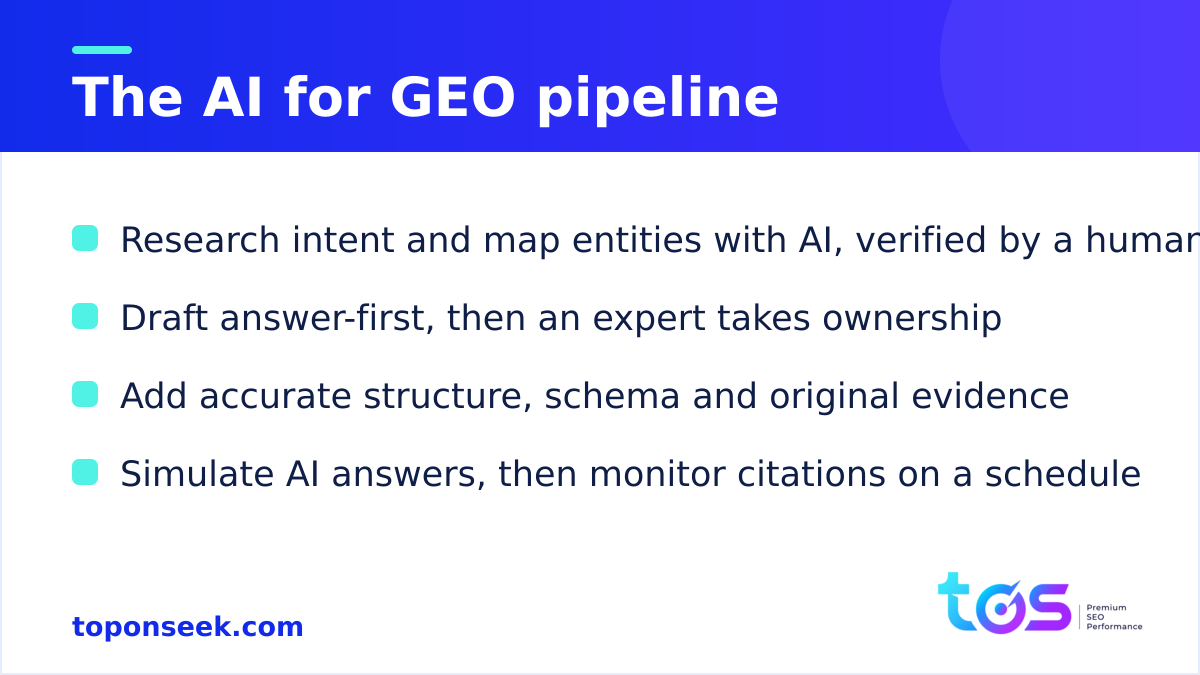
- Research real buyer intent. Start from the questions people actually ask an AI engine about your category, problem, and alternatives. AI is excellent at clustering hundreds of these questions into themes and spotting the sub-questions a strong answer must cover. Guardrail: the shortlist has to reflect genuine commercial intent, judged by someone who knows the business, not whatever the model clusters most tidily. Good vs bad: a good shortlist names the decision the buyer is trying to make; a bad one is a pile of high-volume keywords no prospect would ever type into a chat window. A structured content plan keeps this from becoming a scattershot list of prompts.
- Map entities and coverage gaps. Use AI to build a map of the entities, comparisons, and subtopics a complete answer needs, then find where your existing content is thin or missing. Guardrail: verify the entities are correct and current; models routinely invent plausible-sounding relationships that do not exist. Good vs bad: a good map is fact-checked against primary sources before a word is drafted; a bad one bakes a hallucinated product name or a wrong integration into the outline, where it will survive all the way to publish.
- Draft answer-first, then have a human take ownership. Let AI produce a first draft that leads with a direct, quotable answer in the opening lines and then expands with explanation and evidence. Guardrail: a subject-matter expert edits every draft to add real experience, correct claims, and remove filler. A draft nobody has meaningfully touched is the definition of the content the spam policy targets. Good vs bad: a good draft comes out of review with client-specific detail and corrected claims added; a bad one is published with the model’s confident generalities intact.
- Add structure and machine-readable evidence. Give each page clean headings, concise definitions, useful tables, and factual statements an engine can lift verbatim. AI can propose FAQ blocks and structured data, and a human confirms the schema is accurate to the page. Guardrail: structure amplifies good content and exposes empty content, so never add schema to a page that has nothing worth marking up. Good vs bad: good schema mirrors real on-page answers; bad schema decorates a hollow page and signals to an engine that there is nothing here worth quoting.
- Simulate the AI answer before you publish. Prompt the target engines with your real buyer questions and read how they currently answer, which sources they cite, and where your brand does or does not appear. This turns “will AI cite us” into something you can observe. Guardrail: treat the simulation as a diagnostic, not a scoreboard, because engines vary run to run.
- Monitor citations and iterate. Re-run the checks on a schedule, refresh pages that have dropped out of answers, and expand where new questions emerge. AI speeds the monitoring; humans decide what to change. The detailed method lives in the GEO audit guide.
Throughout, AI is an accelerator, not a substitute for judgment. The same model that drafts a page will also produce confident, wrong statements, so human review of facts and sources belongs in every step, never as an optional final pass.
What does one buyer question look like moving through the pipeline?
The pipeline is easier to trust when you follow a single question through it. Take a B2B software brand whose buyers ask an AI engine, “What is the best inventory management tool for a small manufacturer?” Here is how each stage handles that one query.
- Intent: AI clusters that question with its neighbors — pricing, integrations, migration effort, alternatives — and a strategist confirms the real decision underneath it is “which tool won’t break when we scale,” which reshapes what the page must cover.
- Entities: AI lists the competitors, features, and integrations a complete answer names, and a product expert removes two “competitors” the model invented and adds one the model missed.
- Draft: AI writes an answer-first opening that names the tool and the fit criteria in the first two lines; the expert then adds a first-hand note on a migration edge case AI could not know.
- Structure: a comparison table and an FAQ go in, with schema that matches the visible answers rather than dressing up thin copy.
- Simulate and monitor: the team prompts ChatGPT and Perplexity with the original question, notes whether the brand is named and how it is framed, and schedules a re-check because a page cited this month can drop next month.
No fabricated result is needed to see the point: at every stage the AI moves fast and the human supplies the one thing that makes the answer worth quoting.
Where does AI help and where must humans own the signal?
The table maps the whole pipeline in one view: what the model accelerates, what a person must own, and what goes wrong if the human step is skipped. Read down the last column and the pattern is consistent — the failure is never that AI helped, it is that a human step got skipped.
| Pipeline stage | What AI accelerates | What a human must own | Slop risk if skipped |
|---|---|---|---|
| Intent research | Clustering and prioritizing buyer questions at scale | Confirming genuine commercial intent and audience fit | Pages that answer questions no buyer asks |
| Entity mapping | Drafting entity and topic maps, flagging gaps | Verifying entities and relationships are real and current | Confident but fabricated facts baked into the outline |
| Drafting | Answer-first first drafts, summaries, rewrites | Adding original experience, correcting every claim | Generic, unverified text — the classic scaled-content pattern |
| Structure and schema | Suggesting headings, tables, FAQ, structured data | Confirming schema matches accurate page content | Marked-up pages with nothing worth citing |
| Validation | Simulating answers, auditing citations at scale | Interpreting results and deciding what to change | Assumed visibility that never actually happens |
A tool from TOS
See how ready your website is for AI search
Enter a domain in AI Visibility Check to score the website on the 6 GEO signal pillars that affect how likely ChatGPT, Gemini and Perplexity are to cite it, and compare it with up to three competitors in the same industry.
Score your websiteFree, no account required.
How do you keep AI-assisted GEO content from becoming AI slop?
You keep AI-assisted content out of slop territory by making sure every page carries something a model could not have generated on its own. Answer engines and the humans reviewing quality are both looking, in effect, for signals of first-hand value, and Google frames this as experience, expertise, authoritativeness, and trust (E-E-A-T). AI can shape the wrapper around those signals; it cannot manufacture the signals themselves.
In practice that means a few concrete habits. Include original data — a benchmark you ran, a result you measured, an example from real client work — that appears nowhere else. Attribute pages to a named author with real credentials rather than an anonymous byline. Add specific, dated, checkable detail instead of the timeless generalities models default to. Show your reasoning and your trade-offs, because a genuine point of view is hard to fake and easy for an engine to quote. The test is blunt: if a competitor could regenerate your page with one prompt, it is not yet a citable asset; it is filler.
The difference is visible at the sentence level. A generic paragraph reads, “GEO helps your brand appear in AI answers by improving your content and structure.” A citable one reads, “When we restructured a client’s product page to lead with a one-line definition and a comparison table, that exact table started appearing verbatim in Perplexity answers within the next crawl cycle.” The first could come from any prompt; the second reports something that happened. Engines quote the second kind because it says something specific and checkable.
Two supporting layers help here. Being quotable is its own craft, covered in How to Get Cited by AI. And making sure engines can actually reach your content matters just as much, because a page that is never crawled is never cited — see AI Crawlers for which bots to allow and prioritize.
Which tools support each stage of AI for GEO?
The pipeline is tool-agnostic, but each stage has a natural class of tooling. For intent and entity work, a general reasoning model (ChatGPT, Gemini, Claude) does the clustering while a keyword or people-also-ask source keeps it grounded in real demand. For drafting, the same models produce the answer-first first pass, but the value comes from the human edit layer, not the generation. For structure, a schema generator or CMS plugin speeds up FAQ and structured-data markup that a person then verifies against the page. For validation, purpose-built GEO platforms handle the prompt-record-track loop at scale rather than by hand. TOS keeps a current, ranked shortlist of the last category in The Best GEO Tools. The rule across all of them is the same: a tool that removes a human checkpoint is working against you, not for you.
How do you know your AI for GEO work is paying off?
Measure citations, not output. The wrong metric is how many pages you shipped; the right one is whether target engines name and cite the brand for the questions that matter, and whether the model represents you accurately. Because answer engines change their behavior without notice, a page cited today can be dropped tomorrow, which makes this an ongoing discipline rather than a launch-day check. The structured, recurring version of that measurement — how to run it, what to record, and how often — is laid out in full in the GEO audit guide, so treat that as the method and this as the principle.
What is the AI for GEO done-right checklist?
Before any AI-assisted page goes live, it should clear the same short list. Treat a failed item as a reason to hold, not a nice-to-have.
- Intent verified by a human — the page answers a real question a real buyer asks.
- Every fact checked — no AI claim published without a person confirming it.
- Original value present — at least one piece of data, example, or insight that could not be regenerated by a prompt.
- Named, credentialed author — real expertise attached, not an anonymous or fabricated byline.
- Answer-first structure — a direct, quotable answer in the opening lines.
- Accurate structured data — schema and FAQ that match what the page actually says.
- Crawlable — the relevant AI crawlers are allowed to reach the page.
- Citation-tested — you have simulated the target engines and know your baseline.
- Value over volume — you would publish this page even if you could only publish one this week.
A page that clears the list is AI-assisted but not AI slop. A batch of pages that skips it is precisely the pattern the scaled content abuse policy exists to demote.
How does TOS run AI for GEO for brands?
TOS — Total AIO, GEO Solution — builds GEO programs that use AI to move faster while keeping expert review over every factual claim, so a brand is both ranked in traditional results and cited in AI answers. In practice that means our team starts from the real questions a client’s buyers ask an engine, uses AI to cluster intent, map entities, draft answer-first, and run the citation-testing loop, and then holds every stage to the guardrails above — a named reviewer, verified facts, and at least one first-hand detail per page — before anything ships. Teams that want AI-assisted content their answer engines will actually trust and quote can start from the Generative Engine Optimization guide and build a program with TOS’s GEO team that scales content without scaling risk.
Frequently asked questions about using AI for GEO
Is using AI for GEO against Google’s guidelines?
No, using AI is not against Google’s guidelines; publishing bulk, low-value content is. Google’s stated position is that it judges content by quality and value, not by whether a human or a machine produced it, while its scaled content abuse policy targets mass-produced pages that add little for readers. AI for GEO stays compliant when each page carries verified facts and genuine value, and drifts into risk when volume replaces judgment.
Can AI tools run my GEO program automatically?
Not on their own. AI can accelerate question mapping, drafting, structuring, and citation checks, but the signals that make a model trust a source — accurate facts, real expertise, original data, and a named author — still require human ownership. Fully automated, unverified content tends to be generic and is unlikely to be cited, which is the outcome AI for GEO is meant to avoid.
How much of an AI for GEO page should a human write?
There is no fixed percentage, but a human must own the parts that earn a citation regardless of how much text AI drafted. That means verifying every fact, adding original experience or data, attaching real authorship, and shaping a point of view. The share of words matters far less than whether a person added something a prompt could not reproduce.
Does the August 2026 spam update mean I should stop using AI?
No. The update is best understood as continued enforcement against low-value, mass-produced content, not a ban on AI assistance. The right response is to pair AI with the guardrails in this guide — human review, original value, and citation testing — so that speed does not come at the cost of quality.
What should I track to prove AI for GEO is working?
Track citations, not page count: whether your target engines name the brand for your priority questions and represent it accurately over time. Turning that into a repeatable signal is exactly what a recurring GEO audit is for, so lean on that process rather than counting how many pages you shipped.
Does AI for GEO replace SEO?
No. It extends the same content and technical foundations toward the answer layer. Many AI surfaces still draw on the search index, so strong SEO feeds GEO visibility, while AI for GEO adds research, production, and citation testing on top. The relationship between the two is covered in GEO vs SEO; a durable strategy invests in both rather than treating one as a replacement for the other.
 TOS · Search AI Agency
Get fresh SEO & AI insights — every day
Curated, practical, no spam. Join marketers who read TOS first.