




Every content and SEO team hits this question once AI becomes a daily tool: should you pay $20 a month for ChatGPT Plus, Claude Pro or Gemini, or call the API directly and pay per token? The answer is not just about saving a few dollars — it decides how far you can scale production, how much you can automate, and how well you control costs as volume grows. This guide breaks down the difference between the two, with an updated July 2026 price table and how to work out the real cost for content and SEO work.
Quick summary
- Subscription plans: a fixed monthly fee, best when you write and edit by hand. API tokens: pay per token, best for bulk production and automation.
- A few dozen articles a month done manually → pick a plan; large-scale production → API is cheaper per piece.
- Pricing (July 2026): plans run $8–20/month ($100–200 for premium tiers); mid-range API models cost roughly $1–3 input and $5–15 output per million tokens.
- Either way, you still need editing, fact-checking and GEO/AIO optimization for your content to be cited by AI tools.
How do plans and API tokens differ for content people?
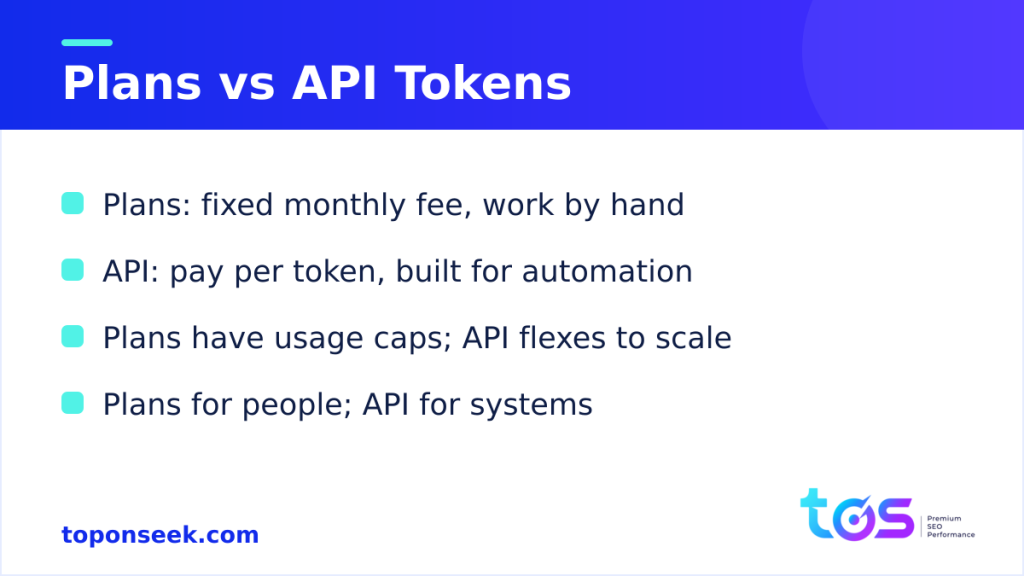
Quick answer: A plan is the right to use a chat interface for a fixed monthly fee — ideal when you sit down to write, edit and brainstorm by hand. An API token is how you call the model from a tool or automated workflow, paying for exactly the tokens you use — ideal when you produce content in bulk or wire AI into a pipeline. In short: plans are for people working by hand; the API is for systems running automatically.
- Billing: plans are charged per user per month; the API is charged per token — both what you send (the prompt) and what the model returns — quoted per million tokens.
- How you work: plans are operated manually through the web/app; the API connects to automation tools (n8n, Make, Zapier), plugins or a content management system.
- Scale: plans have usage caps; the API flexes with demand — write 10 or 10,000 pieces, as long as you watch the budget.
Plan and API token price table (updated July 2026)
Quick answer: Individual plans commonly run $8–20/month, premium tiers $100–200/month. The API is charged per token: mid-range models cost about $1–3 per million input tokens and $5–15 per million output tokens; lightweight models are several times cheaper. The tables below cover the three major providers.
Plans (per user / month)
| Provider | Individual | Premium | Team |
|---|---|---|---|
| OpenAI (ChatGPT) | Go $8 · Plus $20 | Pro $100–200 | Team $25–30/seat |
| Anthropic (Claude) | Pro $20 | Max $100–200 | Team (per seat) |
| Google (Gemini) | AI Pro $19.99 | AI Ultra $99.99–200 | Via Google Workspace |
Reference pricing as of July 2026, subject to change — check each provider’s official page. Source: TOS compilation.
API tokens (USD per 1 million tokens)
| Model | Input | Output | Best for content work |
|---|---|---|---|
| OpenAI GPT-5.6 (Sol) | $2.50 | $15.00 | Flagship, high-quality pieces |
| OpenAI GPT-5.6 (Terra) | $0.75 | $4.50 | Everyday writing |
| Claude Sonnet 5 | $2.00–3.00 | $10.00–15.00 | Long-form, editing |
| Claude Haiku 4.5 | $1.00 | $5.00 | Meta, titles, classification |
| Gemini 2.5 Pro | $1.25 | $10.00 | Research, synthesis |
| Gemini 2.5 Flash | $0.30 | $2.50 | Bulk generation, translation |
Listed per million tokens, updated July 2026. Claude Sonnet 5 has an introductory price of $2.00/$10.00 until 31 Aug 2026, then $3.00/$15.00. Source: TOS compilation from each provider’s official pricing page.
Important note for writers: output tokens (what the model returns) cost 5–6× more than input tokens. The longer the article, the more the cost piles onto the output side. So when optimizing cost, controlling length and requesting the right output format matters far more than trimming the prompt.
When should a content team use a plan?
Quick answer: Choose a plan when you write and edit by hand, your headcount is stable and your volume is moderate. It is simple, the cost is predictable, no engineering is needed, and the interface suits everyday creative work.
- Content writers and SEO specialists using AI to outline, draft, edit and brainstorm.
- Small marketing teams, one account each, producing a few dozen pieces a month.
- Work that needs many back-and-forth turns with the AI, viewed and refined live.
- No need — or no resources — to automate with tooling yet.
Limitation: plans do not scale for bulk production. You cannot have one generate 3,000 product descriptions overnight, nor wire it into a CMS to auto-publish. When you need those, the API is the choice.
When should you switch to API tokens?
Quick answer: Use the API when you produce content at scale or want to automate the workflow — bulk generation, translation, data normalization, wiring AI into a pipeline. The API is cheaper per piece once volume is high enough, but it needs tooling and someone who can configure it.
- Large-scale production: product descriptions, meta descriptions, title variants for thousands of pages.
- Workflow automation: a pipeline that pulls data → generates content → publishes via n8n/Make.
- Bulk translation and localization for multilingual websites.
- Content data processing: keyword classification, topic clustering, competitor research summaries.
With the API, cost varies with usage, so estimate tokens and per-piece cost before you run to pick the right model and set a budget cap.
The real cost math for content work
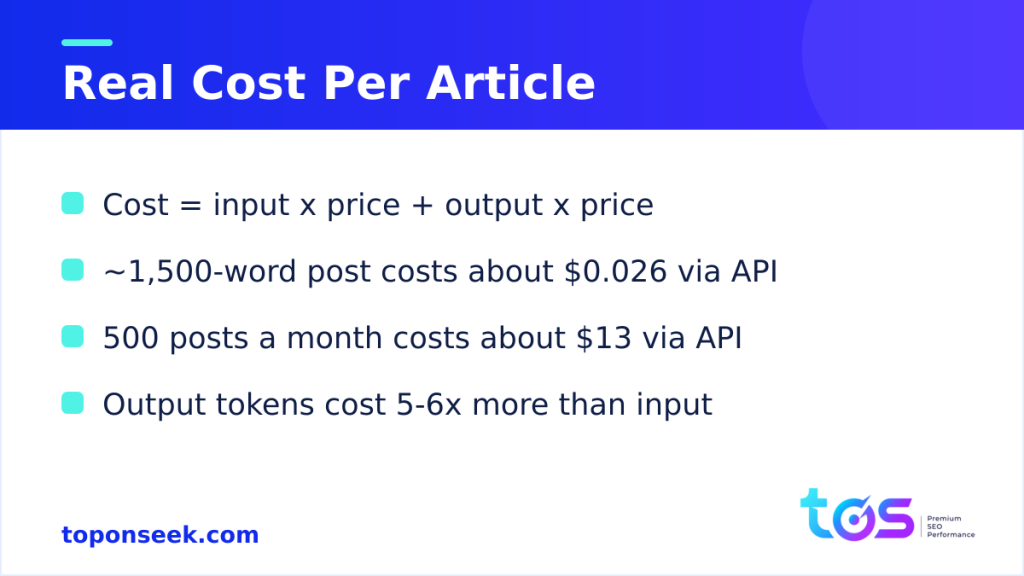
Quick answer: API cost per piece = (input tokens × input price) + (output tokens × output price). A ~1,500-word blog post is roughly 2,000 output tokens; add the prompt and reference material at about 1,000 input tokens. Here are two familiar scenarios.
Scenario 1 — Writing a blog post via API
With a mid-range model (~$2 input, ~$12 output per million tokens), a ~1,500-word post costs ≈ (1,000 × 2 + 2,000 × 12) / 1,000,000 = $0.026 — under three cents per article. Producing 500 posts a month via API ≈ $13 — far cheaper than having each person do it by hand. The trade-off: you need automation tooling plus an editing and review process.
Scenario 2 — A few dozen posts, written by hand
If a writer produces a few dozen posts a month with lots of back-and-forth, editing and live refinement, a $20 plan is simpler and not meaningfully more expensive than the API. This is where a plan makes sense. The rule of thumb: manual work, moderate output → plan; bulk production, need automation → API. The break-even depends on article length and volume, so estimate it up front with a token estimator.
Quality, GEO and AIO when producing content with AI
Quick answer: Whether you use a plan or the API, AI-generated content still needs editing, fact-checking and optimization to perform on both traditional search and AI answers (AI Overviews, LLM assistants). Cheap tokens do not automatically rank content.
- Fact-check: AI can fabricate figures and sources — always verify before publishing.
- Optimize for GEO/AIO: answer-first structure, FAQs, real data and clear schema so AI models cite your content.
- Keep your brand voice: the API helps you scale, but human editing is what sets the work apart.
If you want to know how ready your website is for AI tools, TOS offers a free AI Visibility Check to score your website on 6 GEO signal pillars and benchmark it against competitors.
Recommendation by content-team size
| Situation | Choose | Why |
|---|---|---|
| Individual / small team writing by hand | Plan (Plus/Pro) | Simple, easy to edit, fixed cost |
| Bulk content production | API tokens | Cheaper per piece, scalable |
| Automating content workflows | API + n8n/Make | Wire data, auto-generate and publish |
| Both hand-writing and scale | Combine both | Plans for the team, API for bulk |
Frequently asked questions
Does a ChatGPT Plus plan include API access?
No. A plan only works through the chat interface, while the API is a separate product billed separately per token and requires a developer account. Plan fees do not include any API quota.
Is writing content via API cheaper?
Per piece, the API is usually cheaper at high volume — a single blog post may cost only a few cents in tokens. But if you only write a few dozen posts a month by hand, a plan is more convenient and reasonable.
What is a token and how do you estimate it?
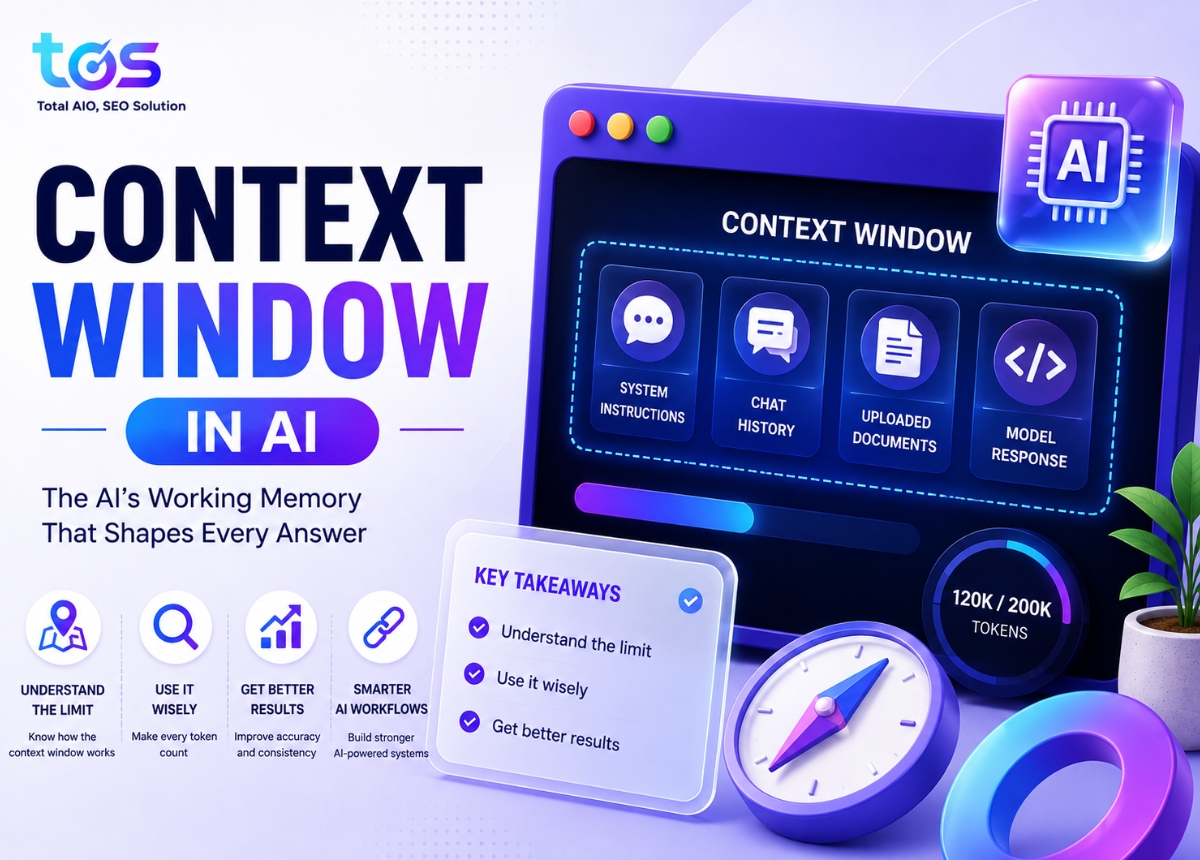
A token is the unit of text a model processes — roughly 1 token ≈ 0.75 English words (some languages use a few more tokens). The API charges for both input and output tokens; output is usually several times more expensive, so longer pieces cost more.
Does AI content affect SEO?
Using AI is not penalized in itself, but low-quality, inaccurate or duplicate content is. Edit, fact-check and optimize the structure (answer-first, FAQ, schema) so your content performs on both search and AI answers.
Where should a content team start?
Start with a plan so the whole team gets used to the workflow and handles manual work. When you need bulk production or automation, estimate the token cost and roll out the API for exactly that part.
Optimize your content for the AI era with TOS
Choosing correctly between a plan and the API helps you control costs, but making content actually rank and appear across AI tools takes strategy. TOS (TopOnSeek) partners with businesses on SEO, GEO and AIO — from building optimized content and measuring brand visibility on LLMs to running an efficient content-production process for the AI era. Contact TOS for advice on the right solution.
Price sources: compiled from the official pricing pages of OpenAI, Anthropic (Claude) and Google (Gemini), updated July 2026. AI service prices change often — please re-check each provider’s official website before deciding.
 TOS · Search AI Agency
Get fresh SEO & AI insights — every day
Curated, practical, no spam. Join marketers who read TOS first.