

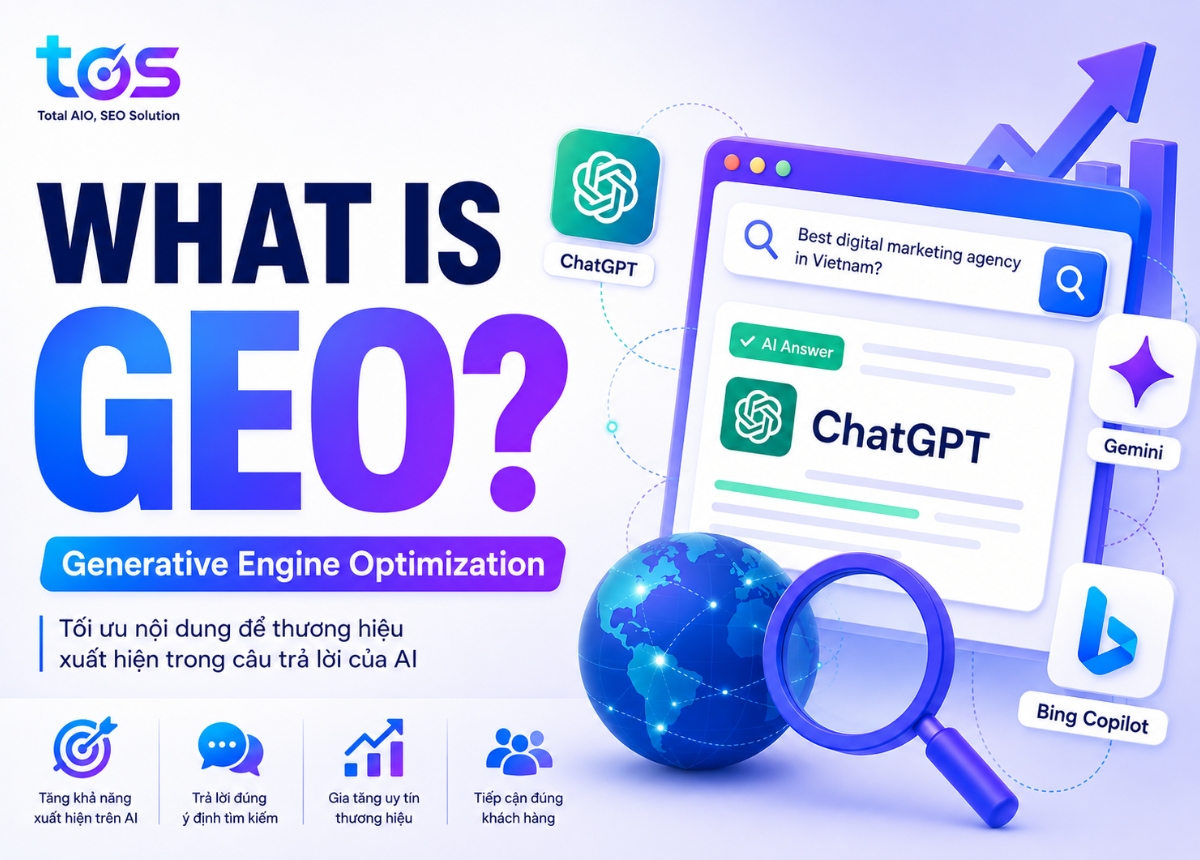



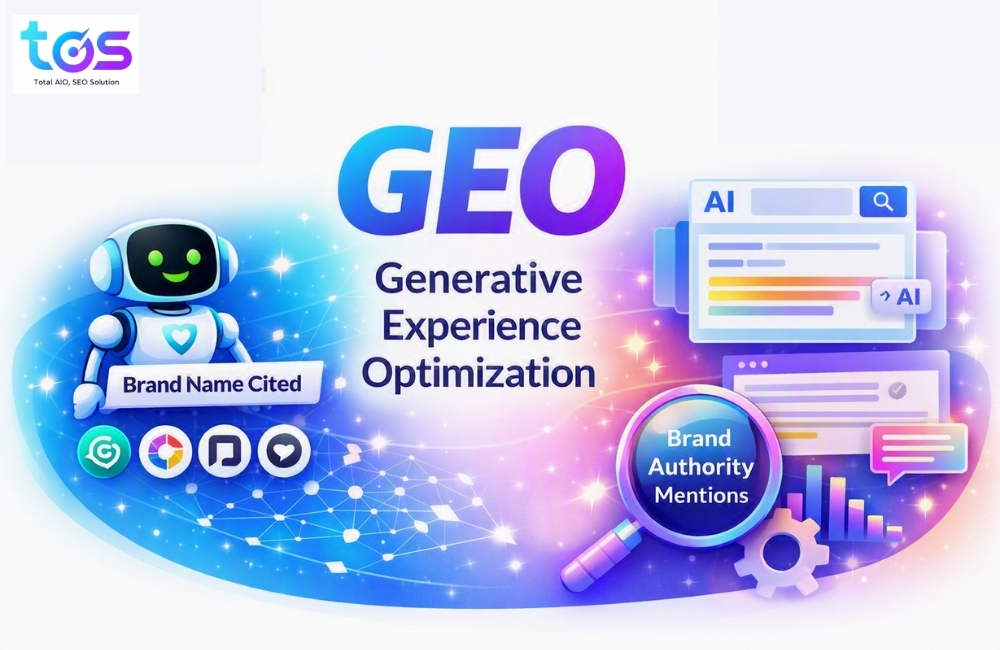
GEO stands for Generative Engine Optimization, the practice of structuring a brand’s content and online presence so that AI systems such as Google AI Overviews, ChatGPT, and Perplexity can find, understand, and cite it when generating answers. Rather than competing for a ranked position in a list of blue links, GEO competes for a place inside the answer itself. The discipline is also referred to as answer engine optimization (AEO) or AI optimization (AIO), depending on the vendor or publication using the term.
For more than two decades, visibility online meant ranking a web page on a search results page. That model still matters, but it no longer stands alone. A growing share of searches now resolve inside an AI-generated summary before a user ever scrolls to a traditional result, and hundreds of millions of people ask AI assistants questions directly instead of typing them into a search box.
What is GEO?
GEO (Generative Engine Optimization) is the practice of helping LLMs and AI-powered search engines find, understand, and cite a brand’s content in generated answers. It applies across Google AI Overviews and AI Mode, AI assistants such as ChatGPT, Claude, Gemini, and Perplexity, as well as voice and chat-based search.
Unlike traditional SEO, GEO focuses on visibility within AI-generated answers, not just rankings and clicks. Key differences include:
- Competition: Brands compete for a limited number of sources selected by AI systems to support an answer.
- Success metrics: Visibility, accurate brand mentions, citations, and inclusion in AI answers can matter more than traffic alone.
- Broader platforms: GEO extends beyond Google to AI assistants that use different retrieval and ranking signals.
Google’s May 2026 guidance confirms that AI Overviews and AI Mode rely on its existing Search ranking and quality systems. Google also states that tactics such as llms.txt, AI-specific content chunking, and AI-specific schema are not required for visibility in its generative AI features.
However, GEO still matters beyond Google. Platforms such as ChatGPT, Perplexity, and Gemini may rely on different signals, including third-party mentions and brand reputation. TOS therefore views GEO as an additional layer on top of strong SEO fundamentals, helping brands improve visibility across the wider AI search ecosystem.
GEO vs SEO vs AEO vs AIO: What’s the Difference?
The four acronyms are often used interchangeably, which causes real confusion for marketing teams trying to decide what to prioritize. The table below separates them by what each one optimizes for and where results actually appear.
| Term | Full name | Optimizes for | Where it shows results |
|---|---|---|---|
| SEO | Search Engine Optimization | Ranking a web page in organic search results | Google’s list of ranked links |
| GEO | Generative Engine Optimization | Being retrieved and cited inside an AI-generated answer | Google AI Overviews, AI Mode, ChatGPT, Perplexity, Gemini |
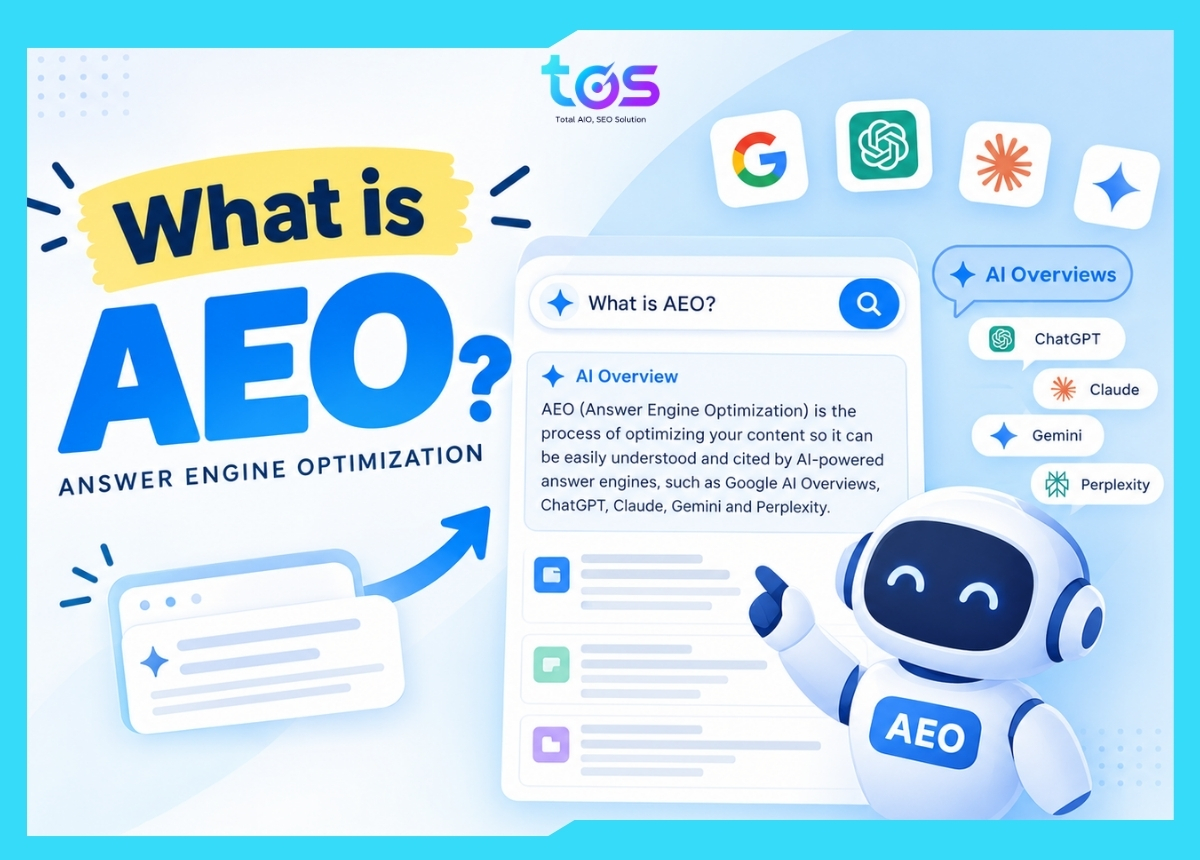
| AEO | Answer Engine Optimization | Structuring a single passage so it can be extracted as a direct answer | Featured snippets, voice assistants, answer boxes |
| AIO | AI Optimization | A brand’s overall footprint across the data AI systems train on and retrieve from | Training data, knowledge graphs, and retrieval sources broadly |
In practice, the four disciplines overlap far more than they compete. Google’s official position – that GEO and AEO are simply SEO applied to a generative interface – reflects how much of the underlying work is shared: crawlable pages, clear entity signals, and demonstrated expertise support all four at once. TOS generally advises clients to treat GEO as an extension of a mature SEO program rather than a parallel budget line item, unless the goal is specifically visibility inside non-Google AI assistants that operate outside Google’s index entirely.
Further reading: GEO vs SEO
Why GEO Matters in 2026?
The case for GEO is no longer theoretical; it shows up directly in search behavior data. Google’s AI Overviews appeared in roughly 43% of tracked US searches by mid-2026, up from about 15% a year earlier, according to market intelligence firm Similarweb’s 2026 Generative AI Landscape report. OpenAI reported that ChatGPT more than 900 million people use ChatGPT each week in February 2026, more than double the figure from a year prior. Muck Rack’s May 2026 research found that earned media accounted for 84% of AI citations across ChatGPT, Claude, and Gemini.
Three consequences follow from this data for any brand running a content or SEO program:
- Zero-click behavior is now common. When an AI Overview or chatbot answer resolves a query directly, a portion of demand that once generated a website visit now generates only an impression – or a citation without a click at all.
- Being cited compensates for fewer clicks. Industry research consistently shows that brands cited inside an AI Overview see materially higher branded search and direct traffic afterward compared with brands that are not cited, even though the AI Overview itself reduced overall click-through on that query.
- The competitive set is different. Because AI systems draw heavily on earned, third-party coverage, a brand’s GEO performance depends partly on signals it does not fully control – media coverage, community discussion, and how consistently other sites describe it – not only on its own website.
How Generative Engines Decide What to Cite
Understanding what an AI system rewards starts with understanding, at a basic level, how it produces an answer. Most generative search features rely on retrieval-augmented generation (RAG): the system retrieves a shortlist of relevant, indexed content in response to a query, then synthesizes a response from that shortlist rather than relying purely on what the underlying model memorized during training. Google’s own May 2026 documentation confirms that its AI features work this way, layered on top of its existing core ranking systems – which is why a page that cannot rank in ordinary Google Search is very unlikely to be retrieved for an AI Overview either.
Four categories of signal consistently influence whether a page is retrieved and cited:
- Crawlability and technical access. Content that AI crawlers cannot reach – blocked by robots.txt, hidden behind client-side JavaScript rendering, or simply not indexed – cannot be retrieved, regardless of quality.
- Entity clarity. AI systems need to resolve who or what a page is about with confidence. Consistent naming, clear “about” and product pages, and structured data help disambiguate a brand from similarly named competitors.
- Signals associated with experience, expertise, authoritativeness, and trustworthiness can strengthen the credibility and citation potential of content, although different AI systems evaluate these signals differently.
- Earned, third-party mentions. Because AI systems weigh outside sources heavily, coverage in trade publications, community discussions, and comparison content that references a brand accurately does more for GEO than publishing volume alone.
Further reading: How to get cited by AI
The 3 Pillars of a GEO Strategy
TOS structures GEO work around three pillars that map directly to the input signals above: content, technical foundation, and authority. None of the three compensates fully for weakness in the others – a technically flawless site with no earned coverage struggles as much as a well-covered brand whose content cannot be crawled.
Pillar 1: Content built for extraction
Make information easy to understand and extract
- Lead each section with a direct, self-contained answer before adding supporting detail – the answer-first structure that AI systems can lift cleanly into a summary.
- Back claims with original data, first-party examples, or named case studies rather than generic statements, since AI systems favor content that adds information beyond what is already common in the index.
- Keep individual claims specific and checkable; vague, promotional language is harder for a retrieval system to extract as a factual answer.
Pillar 2: Technical foundation
Make content accessible to search and AI systems
- Confirm that key pages are crawlable and indexable, and that critical content does not depend on client-side JavaScript that AI crawlers may not render.
- Apply structured data (schema markup) that accurately reflects what is visibly on the page – Article, FAQPage, Product, and Organization schema are the most broadly useful starting points.
- Maintain strong Core Web Vitals and page-loading performance, which affect both traditional rankings and the pool of pages generative systems retrieve from.
Further reading: Technical SEO
Pillar 3: Authority and reputation
Build corroboration beyond your own website
- Pursue coverage in the specific outlets and communities an AI system is likely to draw on for a given topic – industry publications, Reddit and forum discussions, and comparison or “best of” content.
- Keep brand descriptions consistent across owned channels, directories, and third-party profiles, since inconsistent narratives make it harder for a system to reach confident conclusions about a brand.
- Monitor how AI systems currently describe the brand, and correct inaccurate or outdated narratives before they compound across more AI-generated answers.
A curated list of tools that support these three pillars – from AI-visibility trackers to technical crawlers – is available in TOS’s roundup: >>> Further reading: Best GEO Tools
A tool from TOS
See how ready your website is for AI search
Enter a domain in AI Visibility Check to score the website on the 6 GEO signal pillars that affect how likely ChatGPT, Gemini and Perplexity are to cite it, and compare it with up to three competitors in the same industry.
Score your websiteFree, no account required.
How to Measure GEO Performance
Traditional SEO reporting leans on rankings and organic sessions. Those metrics still matter, but they under-report GEO’s impact, since a citation inside an AI answer frequently does not generate a click at all. TOS recommends tracking GEO against a distinct set of KPIs.
| KPI | What it measures | Why it matters |
|---|---|---|
| Citation frequency | How often a brand is cited across a sampled set of relevant AI prompts | Tracks visibility independent of click volume |
| Share of voice | Brand mentions relative to named competitors in the same AI answers | Shows competitive standing inside generative results |
| Sentiment of mentions | Whether an AI system describes the brand positively, neutrally, or negatively | Flags reputation issues before they compound across more answers |
| AI referral traffic | Sessions arriving from ChatGPT, Perplexity, Gemini, and Google AI Overviews | Captures the portion of AI visibility that still converts to a visit |
Further reading:
Common GEO Mistakes to Avoid
Several habits that circulated widely as “GEO best practices” either duplicate existing SEO work or actively work against it. TOS flags the most common ones below.
- Treating GEO as a separate discipline from SEO. Google’s own May 2026 guidance confirms that its generative AI features run on the same core ranking systems as standard Search – a site with weak fundamental SEO will not out-maneuver that with GEO-specific tactics alone.
- Chasing tactics Google has explicitly said are unnecessary. Maintaining an llms.txt file, restructuring content into AI-specific “chunks,” and adding non-standard schema types are not required for visibility in Google’s AI features, according to Google’s own documentation; effort is better spent on the fundamentals above.
- Carrying over keyword-stuffing habits. Generative engines synthesize meaning rather than matching strings, so unnatural keyword repetition adds no citation value and can undermine readability.
- Ignoring platforms outside a brand’s own website. Because a large share of AI citations come from earned, third-party sources, a strategy focused only on owned content structurally caps how much visibility it can capture.
- Optimizing for one language or market only. A brand competing internationally needs GEO signals – entity clarity, structured data, earned mentions – in every market it wants an AI system to recognize it in, not only its home market.
How TOS helps brands improve GEO Visibility in Vietnam and global markets
TOS – Total AIO, GEO Solution – builds GEO work on top of the technical SEO, content, and digital PR foundations it has delivered for clients across Vietnam and international markets for years. Rather than selling GEO as a standalone add-on, TOS audits a brand’s current visibility across Google AI Overviews, ChatGPT, and Perplexity, identifies which of the three pillars – content, technical, or authority – is holding visibility back, and builds a prioritized roadmap from there.
Services relevant to a GEO program include full-service SEO delivery, technical audits, and international SEO for brands expanding beyond Vietnam:
Further reading:
Brands ready to see where they currently stand in AI search can request a GEO visibility audit from the TOS team to establish a baseline before building out a full strategy.
Frequently Asked Questions
Is GEO the same as SEO?
No, though the two overlap substantially. SEO optimizes a page to rank in a list of search results, while GEO optimizes a brand’s content and entity signals to be retrieved and cited inside an AI-generated answer. Google’s own 2026 guidance treats generative AI optimization as an extension of SEO rather than a separate discipline, since both rely on the same underlying ranking systems.
Do I need an llms.txt file for GEO?
Not for visibility in Google’s AI features. Google’s May 2026 documentation states directly that llms.txt is not required and has no positive or negative effect on ranking in AI Overviews or AI Mode. Some other AI platforms may use such files for their own purposes, but it is not a GEO requirement in the way it was often marketed.
How is GEO different from AEO?
AEO (answer engine optimization) focuses narrowly on structuring a single passage so it can be extracted as one direct answer, commonly for featured snippets or voice assistants. GEO is broader: it covers being retrieved and cited across a range of generative AI surfaces, including multi-source, multi-paragraph answers.
Can a brand rank well in Google but still be invisible in ChatGPT? Yes. Google’s AI features draw from Google’s own search index, so strong traditional SEO carries over directly. Standalone AI assistants like ChatGPT and Perplexity combine training data with their own retrieval systems and weigh earned, third-party mentions more heavily, so a brand with strong Google rankings but limited third-party coverage can still be underrepresented there.
How long does it take to see GEO results?
Timelines vary by market and competitive density, similar to traditional SEO. Technical fixes and structured data changes can influence AI retrieval within weeks once content is recrawled, while authority-building work – earning consistent third-party mentions – typically compounds over several months.
What is the first step in building a GEO strategy?
TOS recommends starting with a GEO audit: sampling how a brand’s core topics and branded queries currently resolve across Google AI Overviews, ChatGPT, and Perplexity, then mapping any gaps back to the content, technical, or authority pillar responsible.
 TOS · Search AI Agency
Get fresh SEO & AI insights — every day
Curated, practical, no spam. Join marketers who read TOS first.