











Are you running out of storage space but still need to download and save files? Unable to access cloud services like Google Drive, OneDrive, or Dropbox without an internet connection? TreeSize is a powerful solution to quickly check folder sizes, free up storage, and remove unnecessary files. With TreeSize Free, you get a comprehensive overview of which files are consuming the most space, making it easy to manage your storage efficiently. In this guide, TOS will walk you through how to download and use TreeSize Free quickly and effectively.
Learn more:
TreeSize is a disk space management software developed by JAM Software, specifically designed for Windows. It helps users monitor and manage disk space efficiently. The free version, TreeSize Free, provides essential features for casual use, while the paid versions offer advanced and professional-level tools.

Learn more:
TreeSize Free offers several core functionalities:

Follow these steps to download and install TreeSize Free:
Step 1: Go to the official TreeSize Free website and click “Free Download” in the top-right corner.
Step 2: Choose your preferred installer:
Step 3: Click “Continue with TreeSize Free” at the bottom of the page.
Step 4: After downloading, double-click the installer to start installation.
Step 5: Accept the agreement, click Next, choose the default installation path, and click Finish.
Step 6: Open TreeSize Free as an administrator.
Learn more:
Other Versions:

Once installed, TreeSize can be launched from the Windows Start menu, Start screen, or directly from a folder or drive context menu. Here’s an overview of the key components in the main TreeSize window:

Ribbon Toolbar
The Ribbon provides access to all TreeSize commands. It’s organized into logical sections, such as:
Colored tabs on the right indicate context depending on the current view. Use “Select Directory to Scan” to start scanning a drive or folder.
Selecting Drives or Folders
Folder Tree Overview
The Folder Tree displays the hierarchy of folders or drives being scanned, giving an instant view of the size of each folder.
Drive List
Learn more:
Using TreeSize Free is easier than you might think. Follow these six steps to optimize storage and free up space quickly.
Step 1: Open TreeSize and Select Directory

Step 2: Choose the Folder to Scan
Tip: Start with the C: drive since it usually contains important files and temporary data that may take up a lot of space.

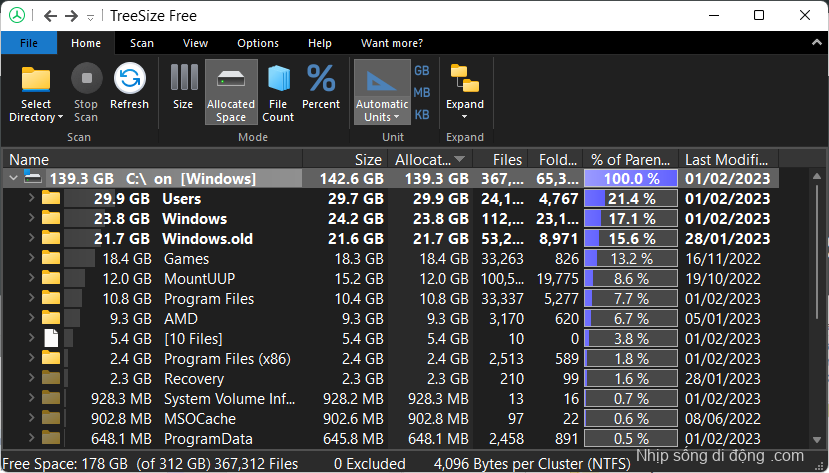
Step 3: Expand Folders and Check Folder Sizes
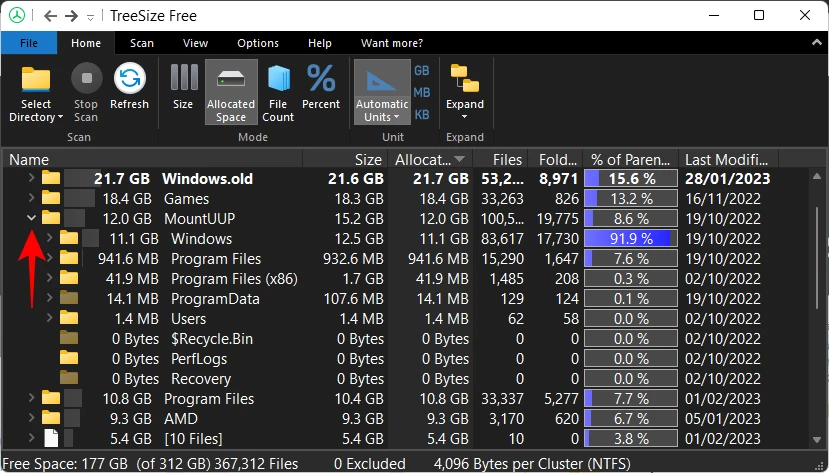
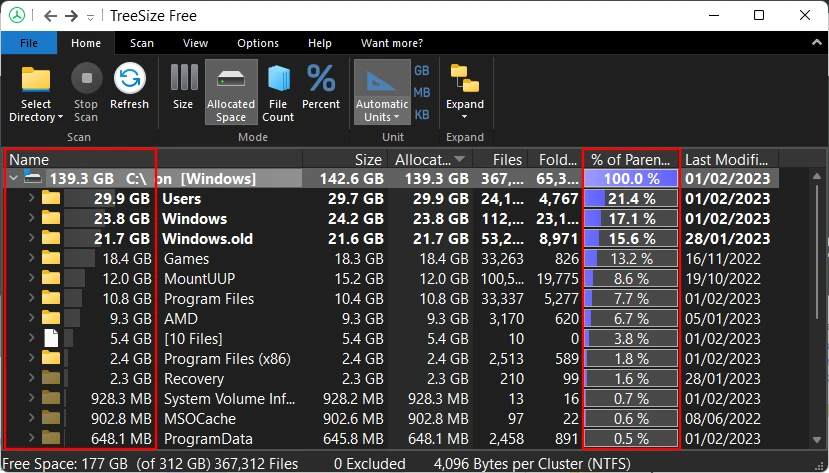
Example: The Windows folder may use 91.9% of its parent folder “MountUUP,” not 100% of the C: drive.

Step 4: Check File Count and Sizes


Step 5: Delete Unnecessary Files

Step 6: Permanently Delete Files


Before moving forward, it’s important to understand how the treemap represents data. Larger boxes represent folders or files that occupy more space.
Example: The Games folder appears smaller than Windows because it uses less disk space.

Different shades of blue indicate folder depth within the parent folder. Example: A subfolder like Virtual Machine at level 5 is light blue, while the main C: drive at level 0 is dark blue.

The folder you select as the parent determines the treemap’s hierarchy. The parent folder is always level 0, and all subfolders and files are color-coded accordingly.
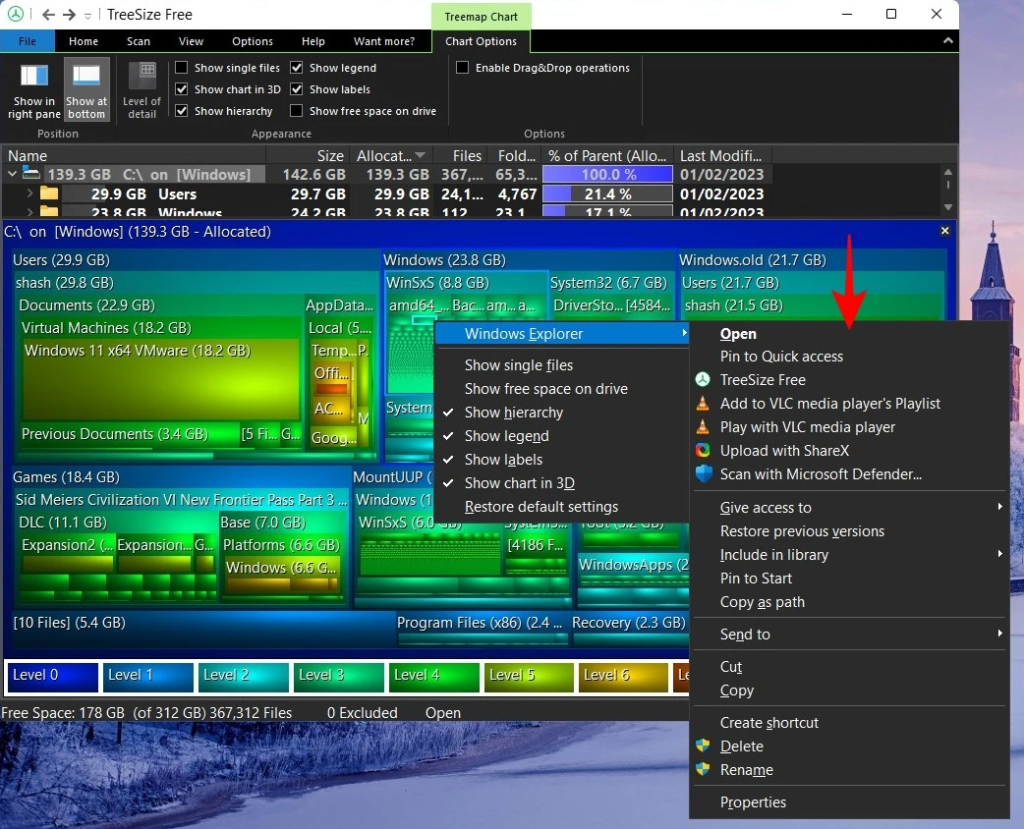
You can view the treemap in 3D by going to Chart Options and checking “Show chart in 3D”.
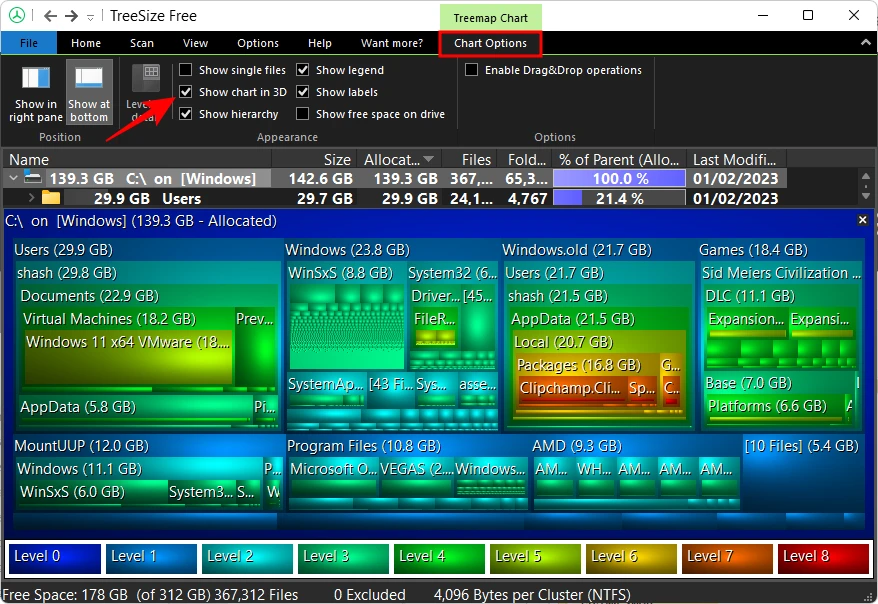
Viewing the TreeSize Treemap in 3D provides several benefits:
This 3D visualization makes it easier for Marketing Executives to identify large files and manage disk space efficiently.
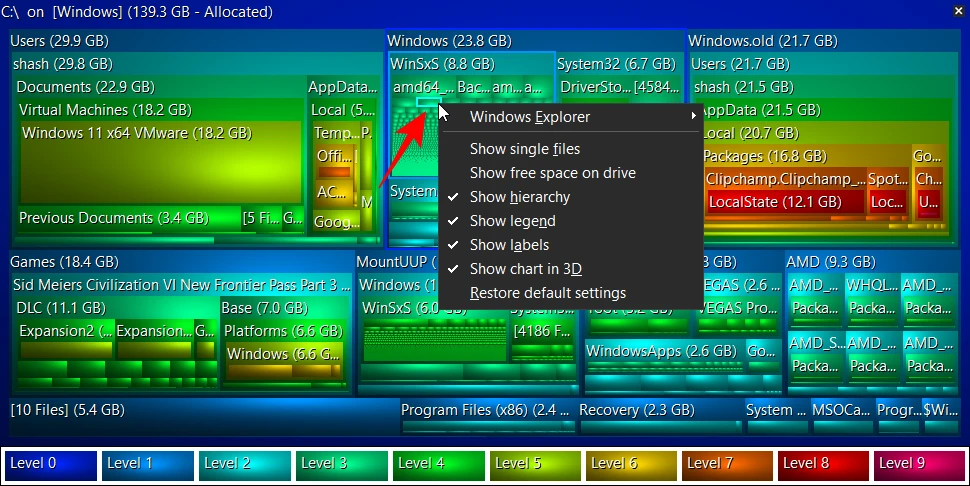
The Windows Explorer option acts as a context menu, letting you perform standard file operations directly from the treemap view.


Learn more:
As a Marketing Executive, your workflow often involves handling large datasets, media files, and project documentation. TreeSize helps you:
TreeSize is a disk space management tool for Windows that allows you to quickly scan folder sizes, visualize disk usage with treemaps, and identify large or unnecessary files. Marketing Executives use TreeSize to efficiently free up storage and optimize their computer’s performance.
Open TreeSize Free, click Select Directory or Select Folder, and the software will scan your chosen drive or folder. The results are displayed in a tree view, showing folder sizes, file counts, and the percentage of space each folder occupies relative to its parent.
Yes. In TreeSize Free, you can select a file or folder and click Delete to move it to the Recycle Bin, or use Shift + Delete to permanently remove it. This helps Marketing Executives quickly reclaim storage and manage disk space efficiently.
The Treemap Chart visualizes folder and file sizes as colored boxes, making it easy to see which items occupy the most space. You can also view it in 3D to highlight hierarchy and quickly access files by clicking on the interactive “bubbles.” This feature simplifies disk management for professional users.
In summary, TreeSize is a powerful disk space management tool that provides detailed insights into folder and file sizes, enabling efficient storage optimization. With its intuitive interface, treemap visualizations, and export options, managing your computer’s storage becomes easier and more efficient. For marketers and professionals, using TreeSize ensures that critical files remain organized and accessible, while unnecessary files are removed, freeing up valuable storage.
Learn more:
TOS collaborates & develops alongside reputable industry-leading partners